
Bryan Elite Concrete installs stamped concrete in Bryan, TX and has worked with decorative flatwork for more than 20 years, serving surrounding cities including Lake Bryan, College Station, Hearne, Caldwell and Gause. Stamped work is ordinary structural concrete that has been textured and colored while it is still plastic, which means every decision that makes it last is made before anyone opens a stamp mat.
Decorative concrete is also the least forgiving work in this trade. A driveway with a slight blemish is still a driveway; a stamped patio with a mismatched color release or a pattern running out of square is a surface you look at every day. It has to be placed, textured, released and sealed on a schedule that the weather is not negotiating with.
The other half of the job is choosing well in the first place. Around here that means picking a color that will not read as an oven in August, a texture that still grips when it is wet, and a pattern scaled to the house rather than to a display board. We would rather talk you out of a finish now than replace it later.
Patterns, Texture and Scale
Choosing a Pattern That Suits the Property
Ashlar slate, random stone, running bond brick, wood plank and seamless texture all read very differently once they cover 500 square feet. We choose from what is already on the property, matching the scale of the brick, stone or siding rather than the sample. A pattern too large for a small courtyard reads as printed paving, and one too fine across a long drive disappears entirely.
Borders, Banding and Sawcut Layout
A contrasting border or a soldier course of banding frames a stamped field and hides the perimeter where a stamp mat cannot reach cleanly. Sawcut patterns can be laid out to double as control joints, so crack control and design are the same lines rather than two grids fighting each other. We draw that layout before the pour, not with the saw afterward.
Seamless Texture and Overlays
Where a pattern would be too busy, a seamless texture skin gives grip and depth without a repeating motif, and it suits large commercial areas and pool surrounds. A stamped overlay applied to a sound existing slab is another route, though it depends entirely on the concrete beneath being worth building on. We test the substrate before quoting an overlay.
Color That Survives This Sun
Integral Color Against Color Hardener and Acid Stain
Integral color is dosed into the mix so the color runs through the full depth, which means a chip or a saw cut does not expose gray. Color hardener is broadcast onto the surface and gives a denser, more intense top layer. Acid stain reacts chemically with the slab for a variegated result that cannot be exactly repeated. Each has a different repair story, and that is usually what decides it.
Heat, and Why the Color Choice Is a Comfort Decision
Surface color drives surface temperature more than any other decorative choice, and on a patio or pool surround used barefoot in a Brazos County summer that is not a small matter. Creams, buffs and light grays run noticeably cooler underfoot than charcoals, deep browns and heavy reds. We raise it at quote time so it is a decision rather than a discovery.
Fade, Release Color and Long-Term Appearance
Stronger reds and blacks shift more visibly over years of full sun than mid-tone earth colors do, and antiquing release adds a secondary color that reads differently once it has weathered. We show samples that have cured outdoors rather than a color card under showroom lighting, because indoor color selection is how people end up with a patio they did not expect.
Where Stamped Concrete Works, and Where It Needs Care
Patios, Walkways and Entries
Patios and entries are where stamped concrete earns its price, because they are seen up close and daily and are not carrying heavy loads. We set fall away from the house first and lay the pattern to that, never the reverse. Getting the drainage right on a decorative slab matters more, not less, since correcting it later means cutting into finished work.
Pool Decks and Wet Areas
Around water the requirement is texture that works wet and barefoot, which points toward textured stamps, broom-finished fields or a non-slip additive in the sealer rather than a smooth trowel. Bryan’s Travis Bryan Midtown Park guidelines take the same line, calling for a broom finish on walking surfaces expected to be routinely wet. We spec both color and texture around bare feet on a hot wet surface.
Driveways and Commercial Areas
Stamped concrete works on a drive provided the structure underneath is designed as a driveway first, with the thickness, reinforcement and base the vehicles require, and the pattern treated as a finish rather than a substitute for engineering. On commercial entries and courtyards, the same rule applies with heavier sections at turning points. Decoration never carries load.
Our Step-by-Step Stamped Concrete Process
Selection and Mock-Up
We agree pattern, color system, release and border, and where the area justifies it we place a sample so you see the combination cured outdoors and at full scale. Choosing from a sample you have walked on removes almost every unwelcome surprise from this kind of work.
Base, Reinforcement and Forming
Underneath, a stamped slab is built like any other: subgrade proof rolled and corrected, base compacted in lifts, reinforcement set on chairs, forms to the agreed grade and fall. Decorative work fails structurally for the same reasons plain work does, and none of them are visible afterward.
Placement, Coloring and Stamping
Concrete is placed, floated and brought to the right window for texturing, then color and release are applied and mats are worked in sequence across the pour. Timing here is measured in minutes, which is why stamped work needs enough crew on site to keep pace with the slab rather than the other way around.
Detailing, Washing and Sealing
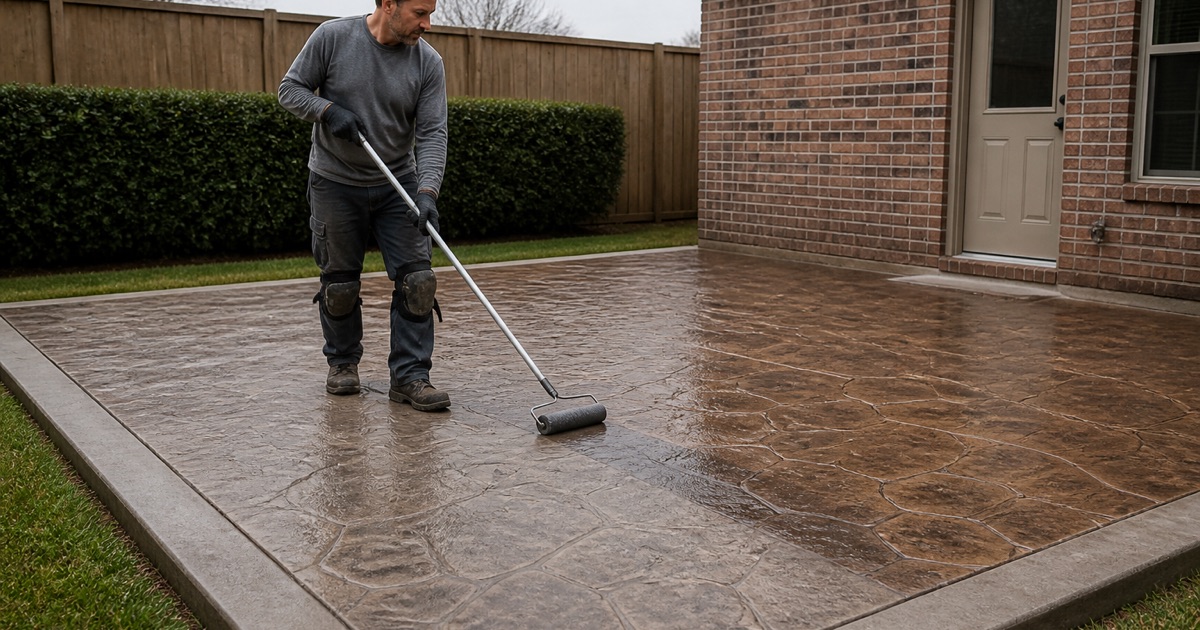
Once cured, the surface is detailed at edges and touch-ups, washed to remove excess release, and sealed with an acrylic cure and seal chosen for the finish. Where the surface is walked on barefoot or gets wet we add a non-slip component to the sealer at this stage.
Maintenance Handover
We tell you which sealer went down, the interval it needs renewing at, and what the surface looks like as that interval approaches. Stamped concrete that is resealed on schedule keeps the color it was sold with; one that is left is the most common reason people believe decorative concrete does not last.
- 20+ Years Experience
- Free On-Site Quotes
- Written Scope and Specs