
Bryan Elite Concrete handles driveway apron and approach work in Bryan, TX and has for more than 20 years, serving surrounding cities including Lake Bryan, College Station, Hearne, Caldwell and Gause. This is the section of concrete that leaves your property and enters the public right of way, and it answers to a different set of rules from everything behind it.
That distinction is the entire reason this page exists. In Bryan the local amendment at Section 14-47 exempts private sidewalks and drives on private property from permits and inspections, and requires permits and inspections for sidewalks and drives in the public right of way. The line is the property line, not a size threshold, and the same job crossing it becomes permitted construction.
Outside the cities the counter changes again. On county road frontage the drive crosses a bar ditch, a culvert has to carry that ditch under it, and the county decides the pipe. Getting the jurisdiction right at the start is what keeps an apron from being a rebuild.
The Approach in the Public Right of Way
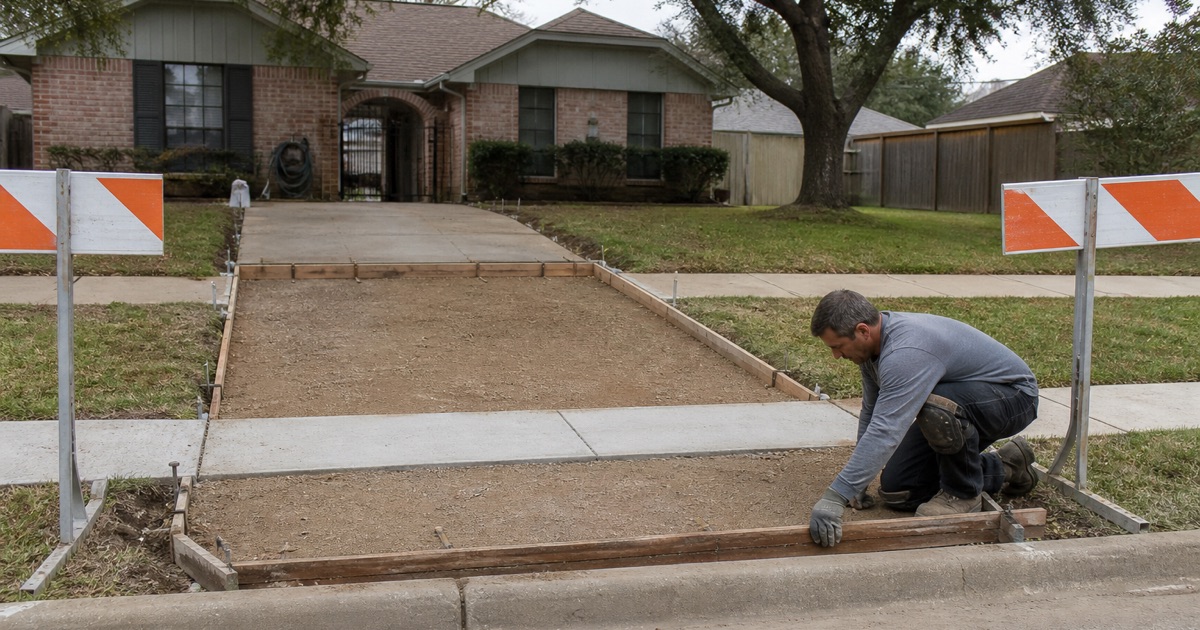
Where Your Driveway Ends and the City’s Begins
The approach is the panel between the street or curb and your property line, and it belongs to a public right of way that the city controls even though you use it daily. That is why the paperwork exists. We identify the actual line on your address rather than assuming it sits at the sidewalk or the fence, because the assumed line and the recorded one are often several feet apart.
Bryan’s Right-of-Way Construction Permit
Under Section 106-170 a permit is required for work in a public right of way, expressly including construction, maintenance or repair of streets and sidewalks. Section 106-172 sets the Type D residential right-of-way construction fee at $100.00, defined as sidewalk, driveway repair or a new driveway not associated with a building permit. We apply, schedule the inspection, and leave the inspection tag on site as the city requires.
Apron Material, Width and Curb Return Radius
Under Section 62-297 all driveway access aprons are to be Portland cement concrete built to the city’s subdivision construction standards, so material is prescribed rather than chosen. Geometry is prescribed too: the minimum curb return radius for a detached dwelling is typically five feet, two feet within a cul-de-sac bulb, and 15 feet for multifamily. We build to those numbers and show you the detail we are working to.
Driveway Culverts on County Roads
Who Decides the Culvert Size
Not the contractor and not the property owner. On county frontage the county road authority determines the pipe diameter, length and type after looking at the location, and the permit is issued against that decision. We take the size from the office issuing the permit and install to it, because a pipe chosen to fit the ditch rather than the drainage is one the county can require removed.
Bar Ditches, Headwalls and End Treatment
A bar ditch is the open roadside channel the culvert has to keep flowing, and the pipe is only half the installation. Ends need proper treatment, whether that is a concrete headwall, reinforced concrete riprap or a safety end treatment, and the backfill over the pipe has to be compacted properly or the drive settles in a trench line across the entrance.
Dip Drives Where No Culvert Is Needed
Some entrances do not need a pipe at all and are built as a dip that carries the ditch flow across the drive surface. These still require a permit in the counties around us, and they still have to be designed so they do not impede drainage, damage the road shoulder or scour the roadway. A dip built by eye is the version that washes out.
Three Jurisdictions, Three Different Answers
The City of Bryan
Bryan deleted the model code’s driveway item entirely and rewrote it as a location test: private property is exempt, right of way is permitted and inspected. It also runs an Engineering Services contractor registration program whose Class IV covers residential driveways, driveway repair and replacement, culvert installation, walkways and sidewalk construction, capped at shallow excavations.
College Station
College Station did not amend that item, so the stock code test still applies there and it turns on height rather than on location. Two addresses seven miles apart can therefore get opposite answers to the same question about the same driveway. We check which city, and which rule, applies before quoting rather than assuming the neighboring practice carries over.
Brazos County and the Extraterritorial Jurisdiction
Outside the city limits the county’s own permit governs access onto a county road, and in Bryan’s extraterritorial jurisdiction the code adopts county standards for street and pavement widths in subdivisions on lots of an acre or more. On a state highway, work on TxDOT right of way needs a TxDOT permit, routed through the city for initial review. Three counters, one driveway.
Repair, Restoration and Who Pays
Apron Repair and the Residential Cost-Share
In Bryan the repair of a defective public sidewalk or driveway is the abutting owner’s duty and expense, independently of any city notice. A 50/50 residential cost-share exists under Section 106-96, but the owner has to initiate it, at least 15 linear feet must need replacement, and the city will not participate in driveway approach replacement on its own. It can ride along when the sidewalk is being repaired at the same time.
Street Cut Restoration
Where a trench or a cut crosses public pavement or a public walk, the restoration goes back to the municipal detail for thickness, base, jointing and finish rather than to whatever was there before. We quote from that detail. A patch that fails inspection is removed and replaced at the contractor’s cost, which is why the detail is the starting point rather than an afterthought.
Registration, Inspection and Getting Signed Off
Texas licenses no concrete contractor at state level, so registration with the city is the credential that exists locally, and right-of-way work is exactly where it is checked. We work to the published specification, keep the permit and inspection sequence in order, and hand you the closed-out job rather than a slab and a problem with the city.
- 20+ Years Experience
- Free On-Site Quotes
- Written Scope and Specs