
Bryan Elite Concrete builds concrete driveways in Bryan, TX and has done for more than 20 years, serving surrounding cities including Lake Bryan, College Station, Hearne, Caldwell and Gause. A driveway is the largest single slab most properties will ever have, it carries the heaviest thing that comes to the house, and it is the first thing anyone sees.
What decides whether it is still flat in fifteen years is almost never the concrete. It is the few inches beneath it. Across most of this city a loose sandy surface layer sits directly on a dense clay, and the boundary between them is where water gathers and where support quietly disappears. We dig, look and price from that, which is why our quotes start with base work instead of ending with it.
Everything below concerns the driveway on your own property, from the garage door out to the property line. The apron that crosses into the public right of way is separate permitted work with its own rules, and we cover that on our driveway approaches and culverts page rather than repeating it here.
Designing a Driveway for What Actually Drives on It
Thickness Set by Load, Not by Habit
A driveway used by two cars is a different structure from one that takes a dually, a boat trailer, an RV or a delivery truck at the door. Thickness is the primary way that difference is handled, and it is the first thing we ask about. Pouring a whole drive to the heaviest case is wasteful; pouring it all to the lightest is how a wheel path cracks in the first year.
Reinforcement That Earns Its Place
Welded wire reinforcement or rebar does not stop concrete cracking, and anyone who says otherwise is selling something. What it does is hold a crack tight and keep the two sides in the same plane so it never becomes a trip edge or a spall. We set steel on rebar chairs and bolsters so it stays in the middle of the slab rather than lying on the ground where it does nothing.
Control Joint Spacing and Sawcut Timing
Concrete shrinks as it cures and it will crack; joints decide where. Spacing is set from slab thickness and the shape of the drive, with the layout drawn before the pour so it looks deliberate rather than improvised. Sawcut timing matters just as much, because cutting too late lets the slab choose its own line and cutting too early ravels the edge.
The Base Under a Bryan Driveway
Subgrade Preparation and Proof Rolling
We strip to firm ground, proof roll the exposed subgrade and undercut anything that pumps or ruts under load. Soft areas get replaced with select fill or a crushed limestone base placed in compaction lifts near optimum moisture content, and compaction is verified rather than assumed. Concrete placed on unverified subgrade is a gamble with your money on the table.
Working With a Duplex Soil Profile
The local pattern is a permeable sandy surface over a much denser clay, and the practical consequence is that water arriving from the roof, the lawn or the street stops at that seam and travels along it. Cutting a four-inch excavation usually lands right on that boundary. Where the exposed subsoil is heavy clay we treat it as its own design problem rather than pretending the slab does not care.
Drainage Designed Before the Forms Go In
Every driveway we build is graded to move water off the slab and away from the house, with the edge condition and the outfall decided at layout rather than discovered after the pour. Under Section 62-296 a driveway also has to be designed so street drainage stays in the street. Getting fall right at layout costs nothing; correcting it afterward means cutting concrete out.
Finishes, Layout and the Look of the Drive
Broom Finish, Exposed Aggregate and Decorative Options
A broom finish is the default for a driveway because it grips when wet and hides ordinary wear. Exposed aggregate gives more texture and better disguises staining. Where a stamped border, banding or an integral color is wanted, we plan it with the joint layout so pattern and crack control are the same lines rather than two competing grids.
Width, Turnarounds, Parking Aprons and Ribbon Drives
Most complaints about a driveway are geometry rather than concrete: too narrow to open a door beside a car, no room to turn, nowhere for a second vehicle. We lay out the width, the turnaround and any parking apron around the vehicles you actually own. In the midtown pattern overlay district driveway width is capped by ordinance, so layout there starts with what is permitted.
Matching a New Drive to Existing Concrete
Where a new drive meets an existing walk, patio or garage slab, we match finish direction, joint layout and color as closely as the materials allow, and dowel the connection where movement has to be transferred. New concrete stays lighter than weathered concrete for a season or more. We say where a seam will always read rather than promising an invisible join.
Our Step-by-Step Concrete Driveway Process
Site Visit, Soil and Layout
We measure the area, look at the fall, check where water currently goes, and open the ground where there is any doubt about what is under it. You get the layout marked out on site so the size and shape are agreed before anything is demolished.
Written Proposal With Thickness and Reinforcement
The proposal names square footage, slab thickness, reinforcement type and spacing, base material and depth, joint layout and finish. That is the level of detail that lets you compare bids properly instead of choosing between two lump sums with nothing behind them.
Demolition, Excavation and Base
Old concrete comes out and is hauled off, the subgrade is cut to depth, proof rolled and corrected, and base material goes in and is compacted in lifts. This is the stage that decides the outcome and the one most easily skimped, which is why it is itemized in the quote.
Forming, Steel and Placement
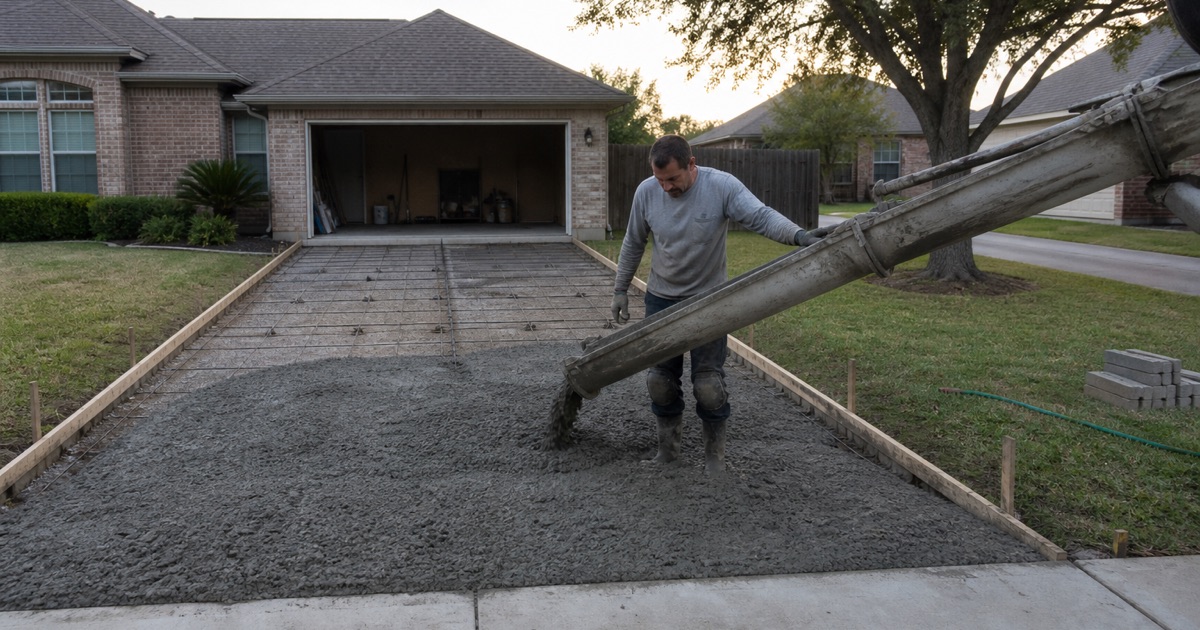
Forms are set to the agreed grade, steel goes on chairs, and the concrete is placed, consolidated and finished in one continuous operation. We work to the mix specified for the job and keep the batch tickets so you can see what actually arrived on site.
Curing, Jointing and Handover
Joints are cut on time, the slab is cured properly and given a cure and seal where appropriate, and we tell you in writing when it takes foot traffic and when it takes a vehicle. Then we walk it with you before the crew leaves.
- 20+ Years Experience
- Free On-Site Quotes
- Written Scope and Specs