
Bryan Elite Concrete pours concrete slab and pad work in Bryan, TX and has for more than 20 years, serving surrounding cities including Lake Bryan, College Station, Hearne, Caldwell and Gause. Shop floors, barn and metal building slabs, RV pads, hot tub pads and equipment pads all get designed from the load and the ground rather than from a standard detail somebody reuses.
A slab is a structure even when it looks like a rectangle of gray. What goes on it, how that load is applied, what the ground beneath will do when it gets wet and where the water arrives from are the four questions that set thickness, reinforcement, base and jointing. Answer them wrong and nothing about the finish rescues it.
That matters more here than the price of concrete suggests. Most of this city has a shallow sandy layer sitting on a much denser clay, and a routine excavation lands almost exactly on that boundary. We test what we find, correct it, and write the resulting specification into the quote so you know what you are buying.
Slabs Sized to What Goes on Them
Shop and Workshop Floors
A shop floor takes point loads from jacks and lifts, dropped tools, solvent spills and sometimes a vehicle that never fully leaves. We design for the heaviest realistic case, thicken where equipment will be anchored, and choose a finish that stays cleanable rather than one that looks best on the day of the pour. Anchor layouts are set before placement, not drilled in afterward.
Barn, Barndominium and Metal Building Slabs
A metal building slab has to carry the structure as well as its contents, which means the perimeter and the column positions are as important as the field of the slab. Bryan’s local amendments require several foundation types to be designed by a Texas licensed engineer, and where your building falls into that category we build to the sealed drawing rather than around it.
RV Pads, Boat Pads and Trailer Parking
A loaded RV or a tandem-axle trailer concentrates far more weight on a small footprint than any car does, and it sits in the same place for months. That combination is what cracks a pad poured at patio thickness. We size thickness and reinforcement to the axle loads, thicken the bearing areas, and set fall so water does not stand under a vehicle that never moves.
Small Pads That Still Need Design
Hot Tub and Spa Pads
A filled spa with people in it is a surprisingly heavy, permanently loaded, permanently wet installation. The pad needs enough thickness and reinforcement to spread that load evenly, and a surface that drains away from the equipment bay rather than into it. We coordinate with the electrical route before the pour so no one is cutting a fresh pad for conduit.
Shed, Playset and Generator Pads
Small pads fail for the same reasons big ones do: no base preparation, no reinforcement and no thought about drainage. We prepare and compact the base under a shed pad in the same way as under a shop floor, at a scale that suits it. Bryan’s code even exempts accessory storage structures on treated wood skids placed on concrete pads, which tells you the pad is expected to be there.
Air Conditioning and Mechanical Equipment Pads
Condensers, mini-split units, pool equipment and standby generators all need a level, stable, non-settling pad with the right anchor pattern and clearances. Settlement here is worse than cosmetic, because it strains line sets, conduit and drain runs. We set these on compacted base with reinforcement rather than dropping a precast block on soft dirt.
What Goes On Under the Slab
Subgrade, Select Fill and Compaction
We strip to firm ground, proof roll the exposed subgrade under load, and undercut anything that ruts or pumps. Replacement material is select fill or crushed limestone base placed in compaction lifts near optimum moisture content and verified rather than assumed. A slab is never better than the few inches directly beneath it, and that is the part nobody can inspect later.
Vapor Retarder, Blotter Layer and Seam Tape
Any slab that will be inside, floored, or used for storage needs a vapor retarder under it, lapped and taped at the seams so ground moisture cannot rise through and ruin coatings, adhesives or stored goods. Where the mix and finishing schedule call for it we add a blotter layer. Retrofitting a vapor barrier is not possible, which makes this a decision with one chance.
Thickened Edges, Grade Beams and Void Form
Loads collect at edges, at columns and under walls, and thickened edges or grade beams put concrete where those loads actually are. On heavier clay, carton void form or degradable void form beneath a grade beam gives the soil somewhere to expand into instead of lifting the structure. We specify these from the ground conditions we find rather than from a standard sheet.
Reinforcement, Joints and Finish
Welded Wire, Rebar and Fiber Mesh
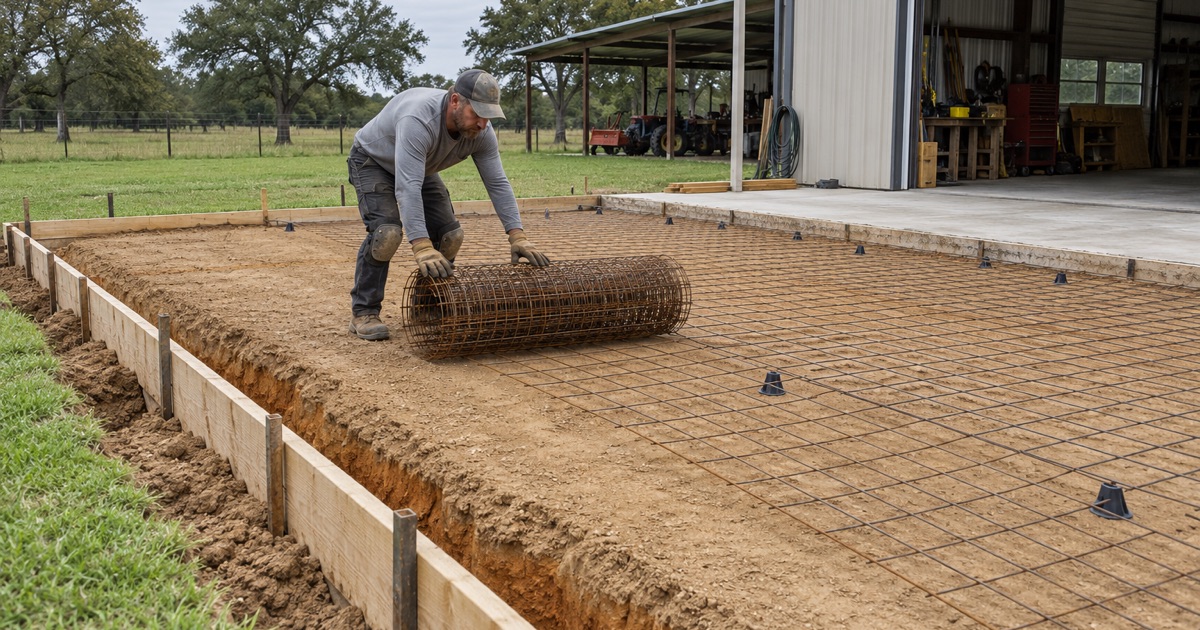
Welded wire reinforcement and rebar control what a crack does once it forms, holding both sides in plane so it never becomes a spall or a trip edge. Fiber mesh helps with early plastic shrinkage but is not a substitute for either. Whatever is specified goes on rebar chairs and bolsters so it sits within the slab instead of on the ground.
Control Joint Spacing and Sawcut Timing
Joint spacing is set from slab thickness and shape, and drawn before the pour so the pattern looks intended. Sawcut timing is the other half: cut too late and the slab chooses its own crack line, cut too early and the edge ravels. On a working floor we also plan joint locations around where equipment and traffic actually run.
Finishes for a Working Floor
A hard trowel finish is dense and easy to sweep and belongs on an enclosed shop floor. A broom finish grips outdoors and under wet conditions. Where a coating is planned later, the finish and the curing method have to suit that coating, so we ask about coatings before placement rather than after somebody’s epoxy fails to bond.
Our Step-by-Step Concrete Slab Process
Load, Use and Site Assessment
We start with what is going on the slab, how it gets there and what the ground is doing, opening the ground where there is any doubt. Every number later in the quote comes from this visit, which is why we do not price slab work off a phone description.
Specification and Written Proposal
You get square footage, slab thickness, base material and depth, reinforcement type and spacing, vapor retarder where applicable, joint layout and finish, all in writing. That is what makes two quotes comparable, and it is the document we are held to on site.
Excavation, Base and Under-Slab Work
The area is cut to depth, the subgrade proof rolled and corrected, base placed and compacted in lifts, and any vapor retarder, void form or conduit installed and inspected before steel goes down. Nothing gets covered until it has been looked at.
Forming, Steel and Placement
Forms are set to grade and fall, reinforcement is set on chairs and tied, and the concrete is placed, consolidated with a mechanical vibrator where the section requires it, and finished as specified. We keep the batch tickets for what arrived.
Jointing, Curing and Handover
Joints are cut on time, curing is carried out properly rather than left to the weather, and we tell you in writing when the slab takes foot traffic, when it takes equipment and when it can be coated.
- 20+ Years Experience
- Free On-Site Quotes
- Written Scope and Specs