
Bryan Elite Concrete builds concrete retaining wall work in Bryan, TX and has for more than 20 years, serving surrounding cities including Lake Bryan, College Station, Hearne, Caldwell and Gause. A retaining wall is a structural job that happens to be landscaping, and confusing those two is where most failed walls in this county begin.
The load on a wall is not the dirt behind it. It is the water in that dirt, and the volume change of the clay holding it. Around Bryan a wall is very often retaining exactly the smectitic clay subsoil that swells when wet, and a wall designed as though it were holding sand has already been given the wrong number.
That is also why we talk about drainage before we talk about facing. Every wall we build gets a drainage aggregate zone, a drain pipe with a real outlet to daylight and backfill material chosen for the job. Get those wrong and no amount of block or concrete keeps the wall vertical.
Poured Concrete Against Segmental Block
What a Poured Wall Does Better Here
A cast-in-place concrete wall is a single monolithic element with reinforcement running through it and a footing carrying it, which means it does not depend on interlock or on friction between courses. Where space behind the wall is tight, where the retained material is heavy clay, or where the wall doubles as a foundation or a raised planter edge, poured is usually the stronger and longer-lived answer.
What Segmental Block Does Better
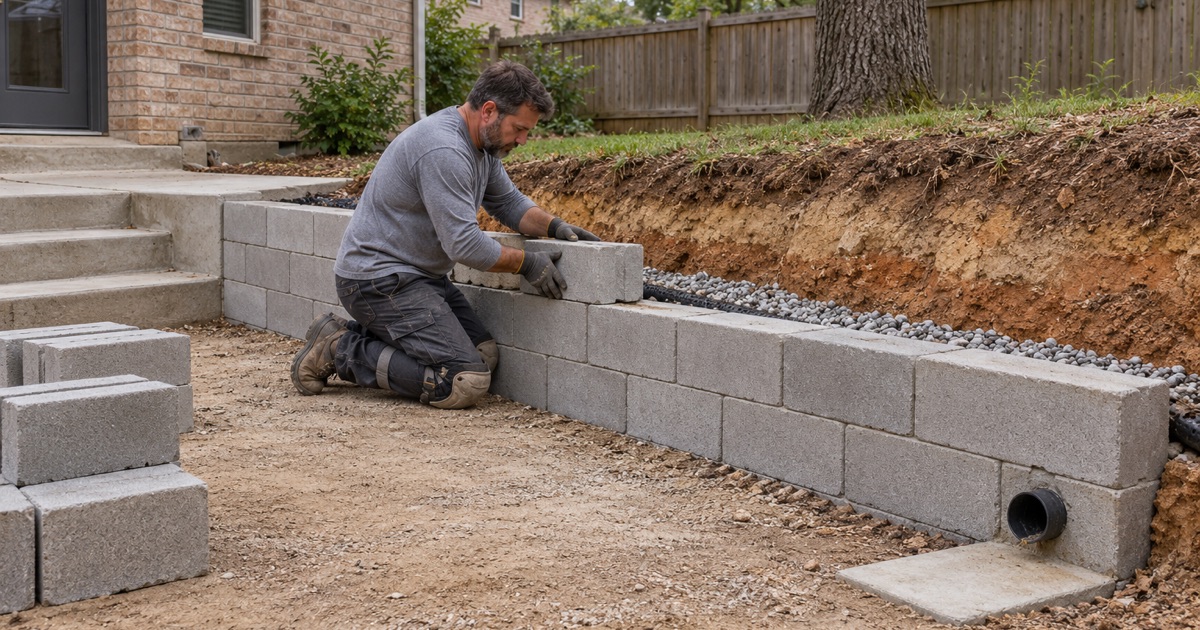
Segmental retaining wall units built to ASTM C1372 go up quickly, absorb minor movement without cracking, and give a wide choice of faces. They rely on a compacted leveling pad, clean wall rock and, above modest heights, geogrid reinforcement laid into compacted lifts. Where there is room to build the reinforced zone properly and the geometry suits it, block is a genuinely good answer.
The Detail That Decides It Locally
Manufactured wall systems require the reinforced zone behind the wall to be built from suitable granular fill, and expansive clay is specifically not suitable there. On many lots around Bryan that means importing select fill and hauling the excavated clay away, and once that cost is on the table the poured wall often wins on price as well as performance. We price both routes honestly rather than quoting whichever we prefer to build.
Building a Wall That Stays Put
Footings, Leveling Pads and Bearing
A poured wall sits on a footing sized to the load and founded below the zone that moves seasonally; a block wall sits on a compacted granular leveling pad, typically specified to 95 percent Standard Proctor density. Both fail the same way when they are founded on soft or disturbed material. We proof roll and correct the bearing surface before anything is built on it.
Drainage Aggregate, Filter and Outlet
Behind every wall goes a zone of clean drainage aggregate, commonly a wall rock in the quarter-inch to inch-and-a-half range with very little fine material passing the number 200 sieve, plus a drain pipe that actually outlets to daylight rather than terminating in the backfill. A wall with no working outlet is a dam, and dams need to be designed as dams.
Reinforcement, Geogrid and Backfill Lifts
A poured wall gets reinforcement sized and placed to the design; a reinforced block wall gets geogrid laid at specified intervals into backfill compacted in controlled lifts, typically around eight inches. Skipping lifts to save a day is the most common shortcut in this trade and the one that shows up as a bulge three years later.
Walls With a Job Beyond Retaining Soil
Terraces, Planters and Seat Walls
Not every wall is holding back a hillside. Terraced beds, raised planters and seat walls carry modest loads but still need drainage, reinforcement and a proper base, because they are usually the walls built with the least engineering and closest to a house. We design these to the same rules at a smaller scale rather than treating them as decoration.
Walls Supporting Driveways, Slabs or Parking
Where a wall is holding up a driveway, a slab or a parking area, the wall and the pavement are one problem, because surcharge load from vehicles changes the design and the pavement’s own drainage has to be resolved above the wall. Handling both in one scope avoids the situation where two contractors each build to their own assumption.
Facing, Caps and Finish
A poured wall can be board-formed, given a form liner texture, veneered, or simply finished cleanly and sealed; a block wall takes its appearance from the unit and the cap. We choose the finish after the structure is settled rather than letting the look drive a system that does not suit the site. Caps and coping matter more than they look, because they keep water out of the top of the wall.
Permits, Engineering and Who Signs Off
When a Wall Needs an Engineer
Bryan’s local code amendments send several foundation types to a Texas licensed architect or engineer, and any wall carrying a structure, a driveway or significant surcharge deserves a design regardless of what the counter requires. We are straightforward about when your project is in that category. A designed wall costs more once and less over its life.
How College Station Handles It
There is no fixed height that triggers an engineer’s seal in College Station, despite that claim circulating locally. Under UDO Section 7.15.A.3.b retaining walls are allowed case by case with the Development Engineer’s approval and where the proposed lot grading is prepared by a licensed professional engineer. The city also requires that a sidewalk between a retaining wall and the public way sit no closer than three feet to the top of the wall.
Site Grading, Drainage and Neighbors
A wall changes where water goes, which makes it one of the few things you can build that alters your neighbor’s property. We look at the whole drainage picture before designing, keep runoff on the paths it is supposed to take, and document what the wall is doing to grade. That is cheaper than a conversation about it afterward.
- 20+ Years Experience
- Free On-Site Quotes
- Written Scope and Specs