
Bryan Elite Concrete has done concrete leveling in Bryan, TX for more than 20 years, serving surrounding cities including Lake Bryan, College Station, Hearne, Caldwell and Gause. Leveling is the repair that saves a slab worth saving: the concrete stays, the geometry comes back, and you keep driving on the same driveway the following morning.
The reason so much flatwork here needs it is underfoot rather than overhead. Rain sinks through the loose sandy surface soil that covers most of this city, meets a much denser clay a few inches down, and runs sideways along that boundary instead of continuing. Wherever that flow finds a joint, an edge or a loose trench, it takes fine material with it, and a slab with nothing beneath it goes down.
That makes leveling a two-part conversation every time. Bringing a panel back to grade is straightforward; keeping it there means closing whatever route the water is using. We quote both together, because a lift sold on its own is a repair with a known expiry date.
What Concrete Leveling Actually Does
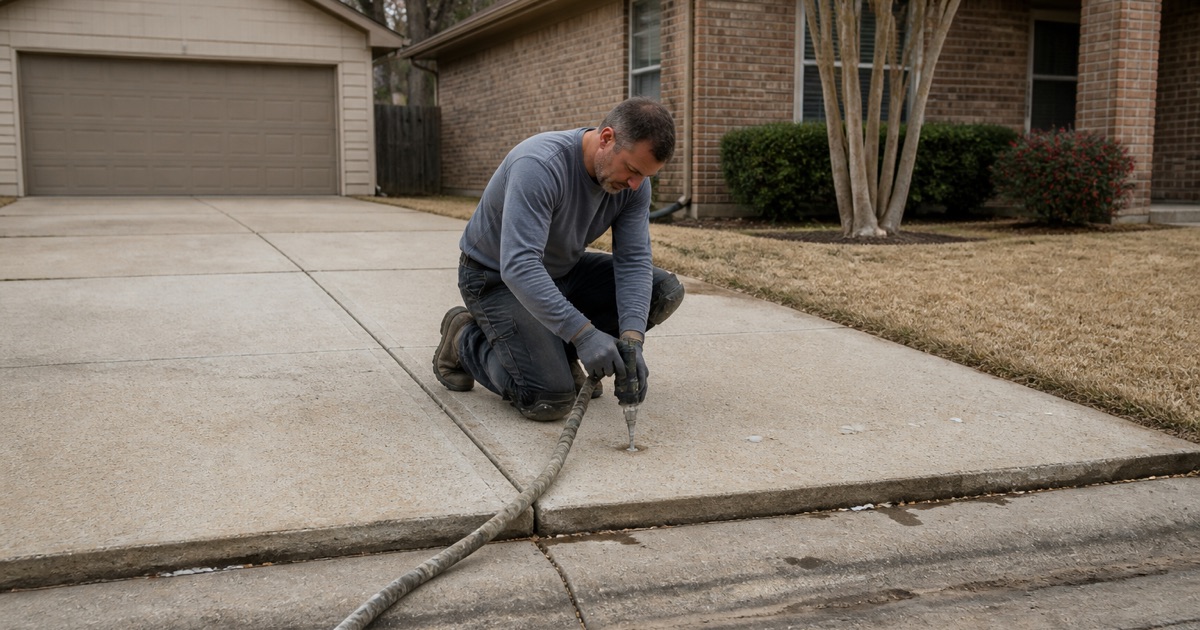
Polyurethane Foam Lifting, Port by Port
We drill injection ports roughly the diameter of a pencil, inject a two-part polyurethane that expands in place, and watch the slab with a laser as it comes up. The foam fills the void first, then begins to lift, so the sequence of ports controls the final plane. It cures in minutes, weighs a small fraction of a cement slurry, and adds almost nothing to a subgrade that is already carrying too little.
Slab Undersealing Where the Grade Is Still Right
Sometimes the panel has not tilted; it has simply lost contact with the ground and now flexes, rocks or drums underfoot. Undersealing fills that gap to restore continuous bearing without changing elevation. It is the cheaper intervention and the right one where the fall still works and the only problem is support, and catching a slab at this stage usually prevents the crack that would otherwise follow.
Mudjacking and Where It Still Makes Sense
Mudjacking pumps a cementitious slurry through larger holes and is a genuinely useful tool on wide, open, well-supported areas where weight is not a concern and budget is. It is heavier, it needs bigger patches, and it takes longer to return to service. We will recommend it where those trade-offs favor you and say plainly when the local subgrade makes the extra load a bad idea.
What Sinks Around Bryan, and Why
Base Washed Out Along Joints and Edges
Open control joints and unsealed slab edges are the two most common entry points we find. Water gets under the panel, moves fine sand out toward daylight, and the void grows from the perimeter inward. This is why leveling work that does not end with joint sealing and an edge detail is unfinished work rather than cheap work.
Utility Trenches and Backfill That Was Never Compacted
A driveway crossing a water, sewer or electrical trench sits on material that was replaced, not on material that was there. If that backfill went in loose or wet, it consolidates for years afterward and the slab tracks it down. The tell is a depression that follows a straight line across the drive. We look for that line before quoting, because it changes what has to be done under the slab.
Seasonal Movement in a Smectitic Clay Subsoil
Beneath the sandy surface across much of the city the clay reads a plasticity index in the high thirties with a linear extensibility around 7.5 percent, which means it genuinely changes volume with moisture. Some seasonal rise and fall is a design condition, not a defect. We distinguish that from true settlement, because a panel that moves and returns should not be chased with repeated lifts.
Where We Level, and Where We Do Not
Driveways, Garage Slabs and Approach Panels
Driveways are the bulk of this work: settled bays, a garage slab that has dropped away from the threshold, a panel at the street that has tipped enough to scrape a bumper. Foam handles all three without removing anything. Returning to service the same day is the reason most owners choose it over replacement even when both are viable.
Patios, Pool Decks and Walkways
A patio that has tipped back toward the house, a pool deck panel that has settled at a coping joint, a walkway with a lip at every second slab: these are comfort and safety problems solved without demolition, planting damage or a week of disruption. Pool deck work in particular benefits, because replacement there means disturbing coping, bond beam and often the tile line.
Interior Slabs and When Leveling Is the Wrong Tool
We are honest about the boundary. Where an interior floor has dropped along with the perimeter of the house, the question is a foundation question and belongs with an engineer, not with a leveling crew. Bryan’s own code requires several foundation types to be designed by a Texas licensed engineer, and we would rather point you there than sell a lift that treats a symptom.
Commercial and Property-Manager Leveling
Trip Hazards on Sidewalks and Parking Lots
For a commercial owner, an abrupt vertical offset is a liability item with a date attached. Leveling removes it without closing the walkway for days, and where the offset is small and the panels are sound, grinding may finish the job faster still. We survey the whole property, list every offset, and price them as one visit rather than one call-out per complaint.
Dock Aprons, Dumpster Approaches and Drive Aisles
Loaded trucks concentrate damage where they turn and stop, so the settlement on a commercial lot is rarely random. Dock aprons, dumpster approaches and aisle entries take repeated point loads and pump water in and out of the base with every pass. We level those and then look at whether the section under them was ever thick enough for the traffic it gets.
Scheduling Around Tenants and Lease Turns
On rental and student housing property, when the work happens matters as much as what it costs. A parking area out of service in the middle of a lease is close to worthless to a manager, so we schedule leveling into the turn between leases and hold the dates. Same-day return to service is exactly why leveling suits that window better than replacement does.
Our Step-by-Step Concrete Leveling Process
Survey and Void Mapping
We shoot elevations across the slab, sound the panels for hollow areas and note where water arrives and leaves. That produces a map of what is unsupported rather than an impression of what looks low, and it is the difference between a planned lift and an expensive guess.
Written Scope and Port Layout
The proposal names which panels are being lifted, roughly how far, the port layout and what happens to the joints and edges afterward. You get square footage and a fixed scope, so our quote can be compared with anyone else’s line for line.
Injection and Live Monitoring
Ports are drilled, foam is injected in sequence, and elevations are watched continuously as the slab comes up. Lifting is deliberately incremental. Rushing the sequence is how a panel gets over-lifted or cracked, and neither of those is repairable by lifting it further.
Joint Sealing and Drainage Correction
Ports are patched, then we seal the joints and edges that let the water in and correct the path that brought it. This is the step that decides whether you are calling us again in two years, and it is included rather than offered as an upsell.
Return to Service and Follow-Up
Most driveways take traffic within an hour of the last port being filled, and we tell you the exact window before we start. We come back after the first heavy rain to check that the drainage correction is doing what it was meant to do.
- 20+ Years Experience
- Free On-Site Quotes
- Written Scope and Specs