Bryan Elite Concrete has handled concrete repair in Bryan, TX for more than 20 years, serving surrounding cities including Lake Bryan, College Station, Hearne, Caldwell and Gause. Repair is the half of this trade where diagnosis matters more than placement, because the same crack can mean three different things depending on what is underneath it.
Almost everything we are called out to repair here traces back to water rather than to concrete. Under most of this city a thin sandy surface sits on a much denser clay, water travels down until it reaches that boundary and then travels sideways, and it carries fine material with it. The slab is fine; the support it was placed on is not.
So we start every repair by working out what moved and why, then price the fix against that. A slab lifted back to grade over a void that is still filling with water is a repair you will buy twice, and telling you that before you spend money is worth more than the work itself.
Repairs That Fix the Ground, Not Just the Concrete
Voids and Washed-Out Base Under a Slab
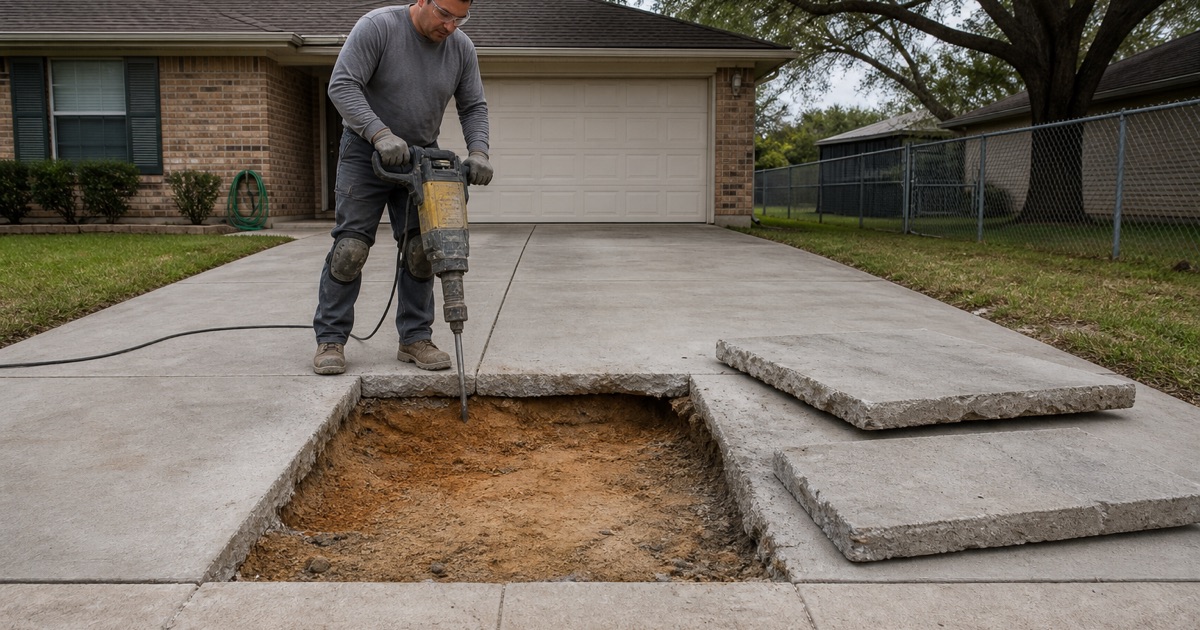
A void under a slab is rarely a settlement problem in the ordinary sense; it is material that has been carried away. We probe and sound the panel to map where the support has gone, then trace the entry point, which is usually a failed joint, an unsealed edge or a utility trench that was backfilled loose. Filling the void without closing that path just resets the clock.
Slab Undersealing and Polyurethane Foam Lifting
Slab undersealing fills the gap beneath a panel to restore continuous bearing; polyurethane foam lifting does the same and raises the slab back to grade at the same time. Foam is injected through small ports, expands, cures within minutes and weighs a fraction of a cement slurry, which matters on a saturated subgrade that will not carry more load. We use it where the concrete is sound and the geometry is the only thing wrong.
Subgrade Proof Roll and Compaction Before Any Repour
Where a panel has to come out, the exposed subgrade gets proof rolled and corrected before new concrete goes anywhere near it. Soft spots get undercut and replaced with select fill or a crushed limestone base placed in compaction lifts near optimum moisture content. Concrete placed straight onto disturbed clay repeats the failure with a newer surface on top of it.
Cracks, Joints and Trip Hazards
Structural Cracks Against Shrinkage Cracks
A hairline crack that runs between control joints and stays hairline is shrinkage doing what shrinkage does. A crack that steps vertically, widens seasonally, or opens across a slab with no joint near it is a support or movement problem. We tell you which one you have and what each costs, because those two diagnoses justify completely different invoices and only one of them justifies replacement.
Joint Resealing With Backer Rod and Sealant
Control joints and expansion joints are the designed path for movement, and once the sealant in them fails they become the fastest route for water into the base. Resealing is cheap, unglamorous and prevents most of the repairs on this page. We clean, size a backer rod to the joint and place fresh sealant so the joint can still move without letting water below.
Concrete Grinding for Vertical Offsets
Where two panels have gone out of plane and left an abrupt vertical lip, concrete grinding takes it back to a walkable transition in a single visit, with no forms, no cure time and no color mismatch. It is the right answer when the panels are sound and supported. It is the wrong answer when the offset exists because one panel has lost its base, which is why we check support first.
Surface Failures: Spalling, Scaling and Delamination
Why New Concrete Flakes in Its First Year
Spalling and surface delamination on young concrete almost always trace back to placement day: water added at the truck that pushed the water to cementitious ratio too high, a surface troweled closed before bleed water had finished rising, or curing that was cut short. The paste at the top is weaker than the concrete beneath it and separates. We identify which of those happened before quoting a fix.
Partial-Depth Repair and Bonded Overlays
Where the damage is confined to the top of the slab and the body of it is sound, we saw a clean perimeter, remove to solid material and place a bonded repair or an overlay across the area. The requirement is a substrate that will hold a bond. An overlay placed over concrete that is still delaminating fails at the bond line and takes the repair budget with it.
When the Surface Problem Is Really a Base Problem
Widespread scaling with cracking and panels that rock underfoot is not a finishing story. That combination says water is moving under the slab and the surface is simply where it shows. We check for movement and voids before recommending any surface treatment, because resurfacing a slab that is still settling is the most expensive way to buy another year.
Repairs the City or County Has to Approve
Public Sidewalk and Driveway Approach Repair in Bryan
In Bryan the repair of a defective public sidewalk or driveway is the abutting owner’s duty and expense, and Section 106-92 makes that duty exist whether or not the city has sent a notice. Section 106-96 offers a 50/50 residential cost-share the owner has to initiate, with a minimum of 15 linear feet in need of replacement and defined defect thresholds. We handle the work as permitted right-of-way construction and tell you whether your sections would qualify.
Street Cut Restoration to the Municipal Detail
A cut through public pavement or a public walk goes back to the published municipal detail for thickness, base, jointing and finish, not to a patch that matches what was there. We quote from that detail and leave the inspection tag on site. A restoration that fails inspection is removed and replaced at the contractor’s expense, which is the whole argument for building it right the first time.
Commercial Lot Repairs: Curb, Valley Gutter and Dumpster Pads
On commercial property the failures cluster where trucks turn and where water concentrates: broken curb, cracked valley gutter and dumpster pads pounded out by collection vehicles. Bryan regulates the dumpster pad in two separate chapters whose dimensions do not agree, so a rebuild has to satisfy the stricter of the two. We rebuild those sections to a heavier detail than the stalls around them.
Our Step-by-Step Concrete Repair Process
Assessment and Cause Diagnosis
We walk the area, sound the panels for voids, measure offsets and fall, and look at where water arrives and leaves. The output is a cause, not a photograph. Nothing gets priced until we can say why the concrete is in the condition it is in.
Written Scope, Thickness and Reinforcement
The proposal names the panels involved, the removal depth, the base work, the slab thickness and the reinforcement, plus the square footage. That is deliberate: it lets you set our number beside another contractor’s and see where the difference actually is rather than comparing two lump sums.
Jurisdiction and Permit Check
We confirm whose rules apply before scheduling. Private flatwork on private property in Bryan needs no permit or inspection, work in the right of way does, and county road frontage is a separate regime again. That check costs a phone call and saves weeks.
Execution: Lift, Repair or Replace
The crew does what the diagnosis called for, whether that is foam lifting, joint work, partial-depth repair or full removal and replacement. Where we replace, the subgrade is corrected and compacted first and reinforcement is set on chairs rather than pulled up during the pour.
Curing, Sealing and the Follow-Up
New work gets cured properly and, where appropriate, an acrylic cure and seal. We tell you when it takes foot traffic and when it takes a vehicle, in writing, and we come back to look at the joint work after the first heavy rain rather than waiting for you to call.
- 20+ Years Experience
- Free On-Site Quotes
- Written Scope and Specs