Concrete Contractor in Bryan, TX

Twenty years of driveways, patios, slabs and repairs across Bryan and Brazos County, quoted from the ground the concrete will actually sit on.

Bryan Elite Concrete has poured, repaired and replaced concrete across Bryan, TX for more than 20 years: driveways, patios, slabs and pads, sidewalks, retaining walls, pool decks, stamped and decorative work, resurfacing, leveling and commercial flatwork. We are a concrete contractor rather than a remodeler who subcontracts flatwork out, so the slab, the base beneath it and the joints holding it together are the whole job.

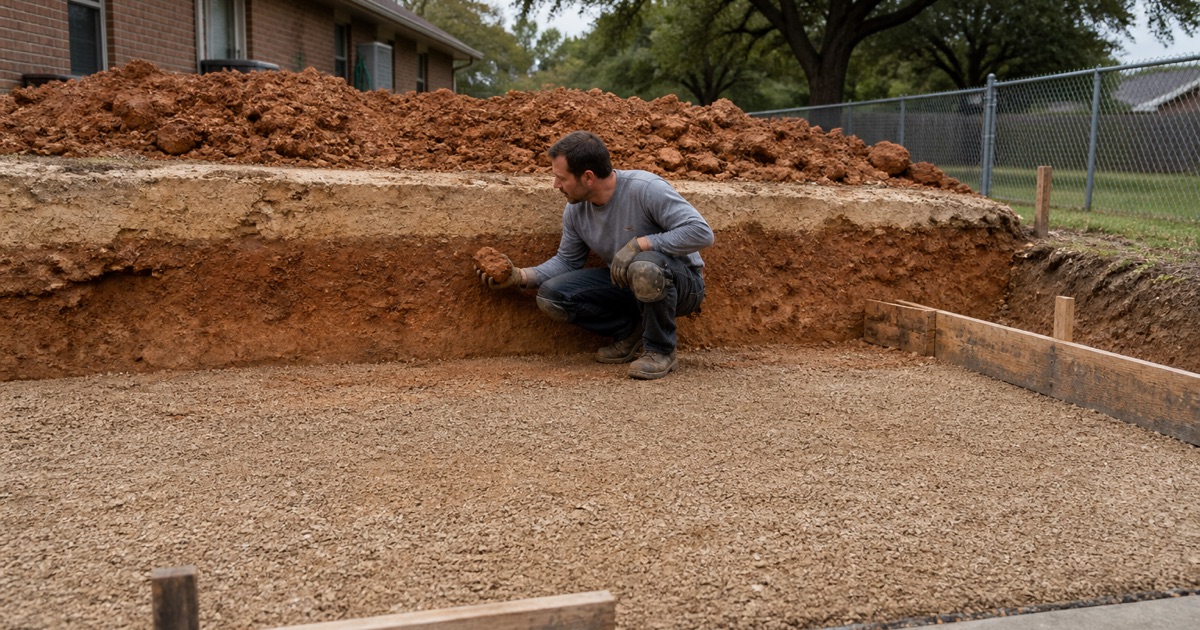
Most of the ground inside this city is a thin sandy loam sitting directly on a smectitic clay subsoil, and the change happens shallower than people expect. On the Zack soils covering roughly a quarter of the mapped soil area, the sandy surface runs a plasticity index of 4 and ends three to seven inches down, while the clay beneath it reads a plasticity index of 38. A four-inch excavation cuts through the harmless layer into the one that moves.

That is why every quote begins with what the slab will sit on and where the water goes, and why we name the rules your address answers to before anything else. Bryan, College Station and Brazos County do not agree with one another, and the line between two of them can run down the middle of a street. Thickness, reinforcement and square footage go in writing before anyone breaks ground.

Get Your Free Quote

Fast response • No obligation

So we can reach you about your request.

So we can send you a confirmation after you submit this inquiry form.

  • 20+ Years Experience
  • Free On-Site Quotes
  • Written Scope and Specs

What we do

Our Services

Concrete contractor serving Bryan and the Brazos Valley

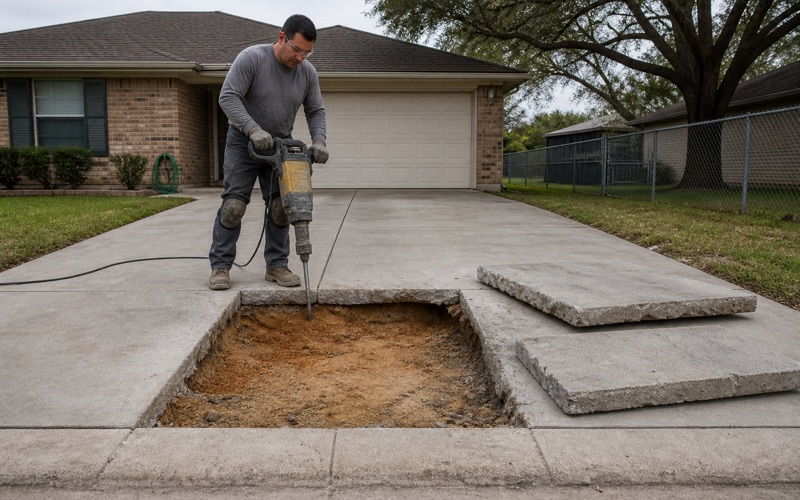
A failed driveway slab in Bryan being broken out in sections, the four inch edge and the washed out base showing underneath.

Concrete Repair

Concrete repair in Bryan, TX for sunken slabs, working cracks, failed joints, spalling surfaces and washed-out base under driveways and patios.

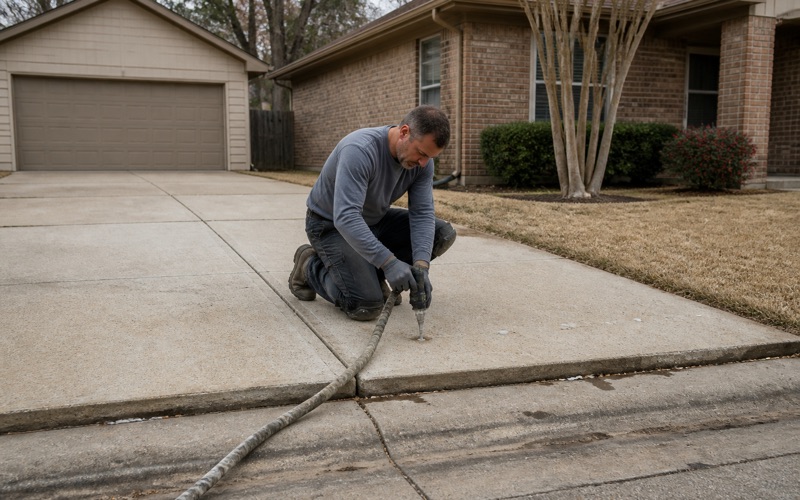
Polyurethane foam being injected through drilled ports to lift a sunken driveway panel in Bryan back to grade.

Concrete Leveling

Concrete leveling in Bryan, TX using polyurethane foam to lift sunken driveways, patios, walkways and pool decks back to grade in one visit.

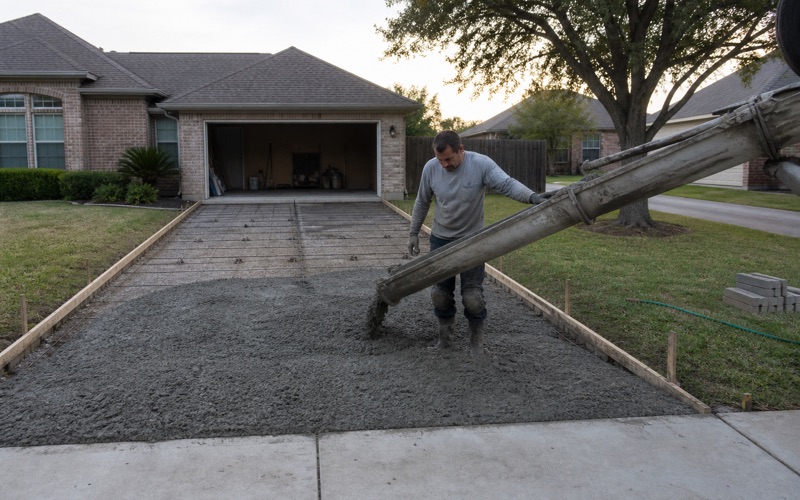
Ready mix concrete discharging down the chute into the formed driveway at a Bryan house, the placer guiding the chute lip.

Concrete Driveway

New and replacement concrete driveways in Bryan, TX, built on a proof-rolled base with thickness, reinforcement and joint layout set to the load.

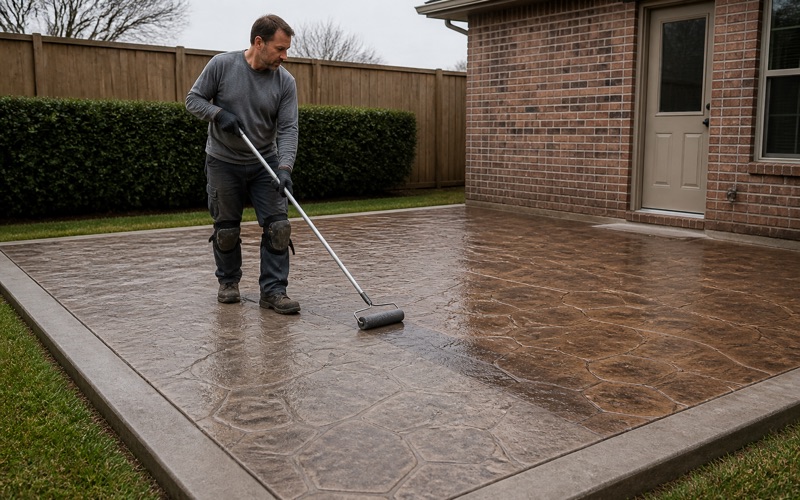
Sealer being rolled onto a finished stamped concrete patio in Bryan, bringing up the color and pattern behind the roller.

Stamped Concrete

Stamped concrete patios, pool decks, walkways and entries in Bryan, TX, with pattern, color and texture picked for full sun and wet, bare feet.

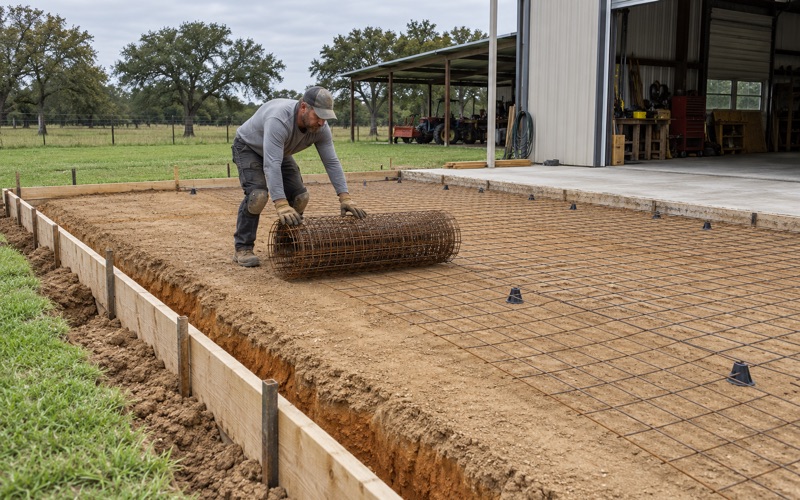
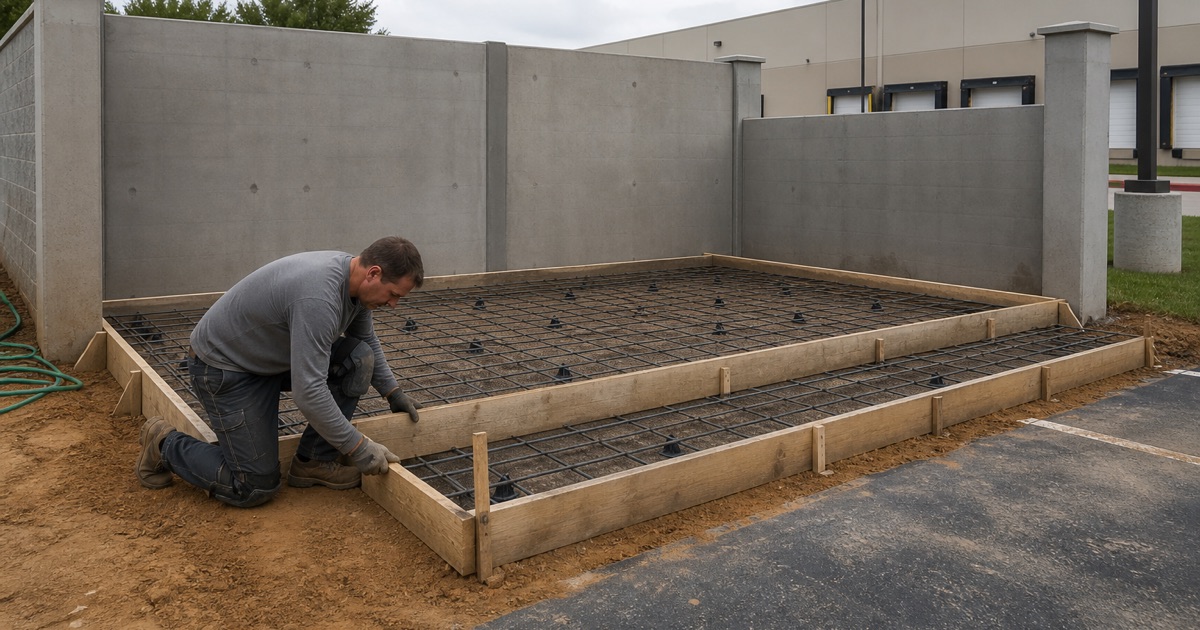
Welded wire mesh being rolled out over compacted base inside the forms for a shop slab in Bryan.

Concrete Slab

Concrete slabs and pads in Bryan, TX for shops, barns, metal buildings, RVs, hot tubs and equipment, sized to the load and the ground beneath.

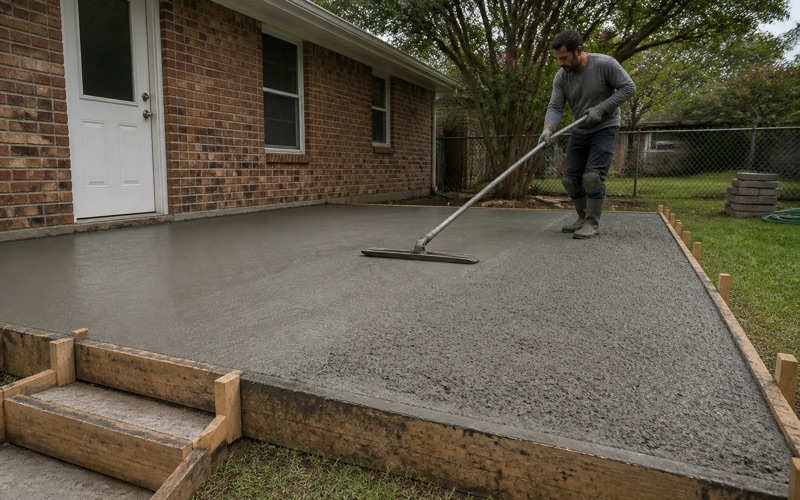
A fresh patio pour in Bryan being bull floated flat, the float running out across the wet surface.

Concrete Patio

Concrete patios in Bryan, TX sized around your furniture and routes, graded away from the house, in broom, exposed aggregate or stamped finishes.

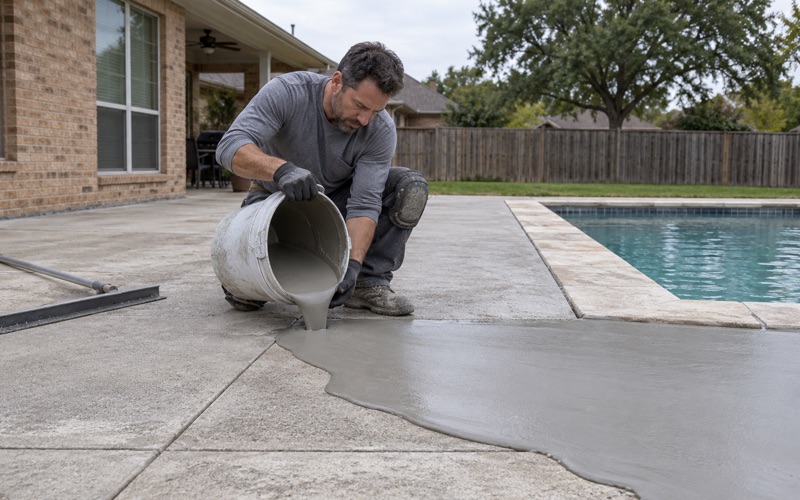
A bonded overlay being poured out of a bucket onto a prepared pool deck in Bryan, ahead of the spread.

Concrete Resurfacing

Concrete resurfacing in Bryan, TX with bonded overlays, stamped toppings and spray textures for pool decks, patios, shop floors and entries.

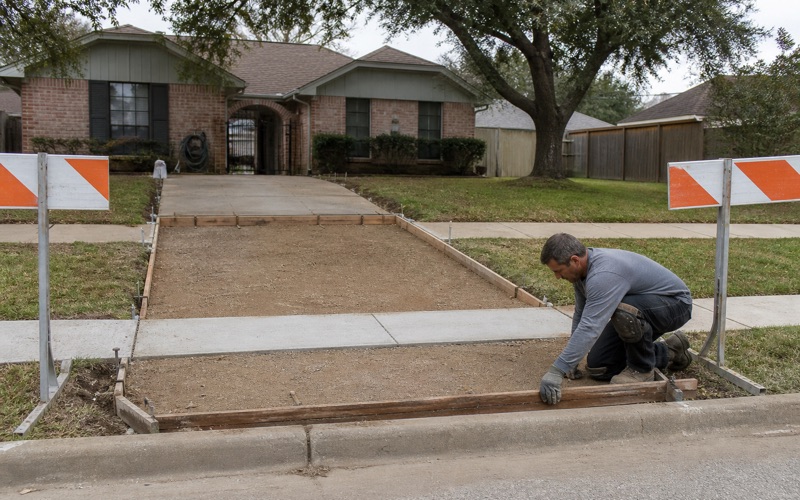
A driveway approach being formed in the public right of way in Bryan, dowels set through the header at the curb.

Driveway Apron

Driveway aprons, approaches and culverts in Bryan, TX handled as permitted right-of-way work, with the permit, staking and inspection included.

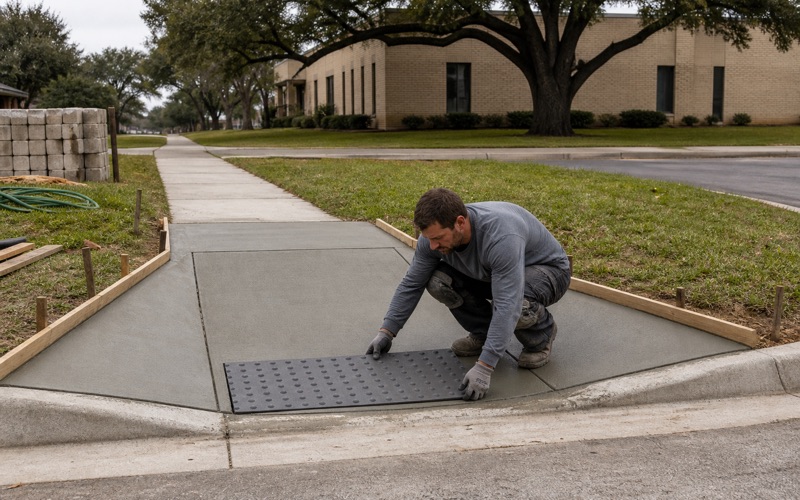
A detectable warning panel being set into the green concrete of a new curb ramp landing in Bryan.

Concrete Sidewalk

Concrete sidewalks and walkways in Bryan, TX, from private garden paths to public walks, curb ramps and trip-hazard repairs on existing panels.

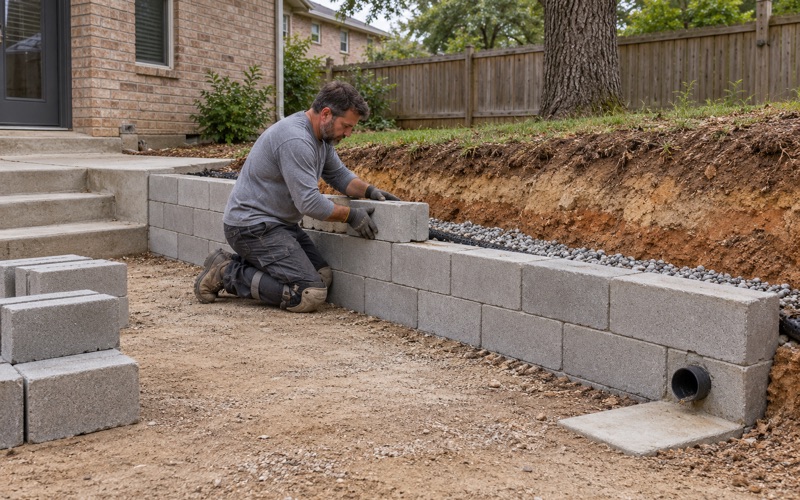
A segmental block retaining wall going up course by course in Bryan, drainage stone and drain pipe behind the first courses.

Concrete Retaining Wall

Concrete retaining walls in Bryan, TX, poured or segmental block, engineered around local clay with drainage aggregate and a working drain outlet.

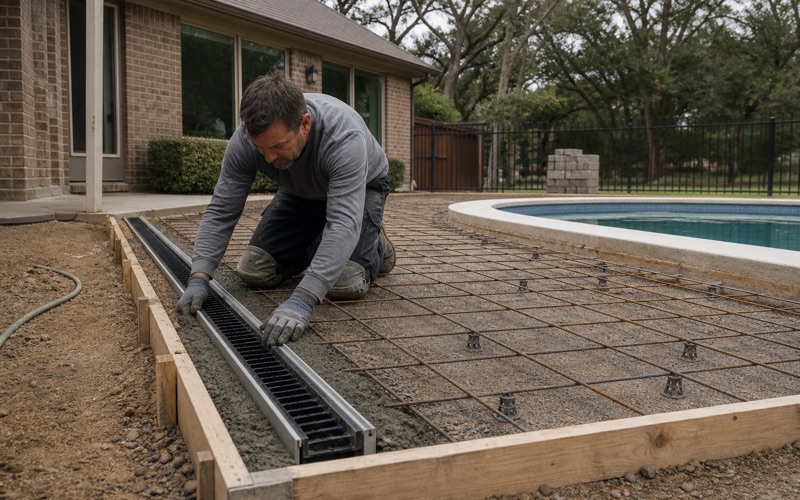
A trench drain channel being bedded along the low edge of a formed pool deck in Bryan before the pour.

Concrete Pool Deck

Concrete pool decks in Bryan, TX built for wet, bare feet and full sun, with slip-resistant texture, cooler colors and drainage away from the pool.

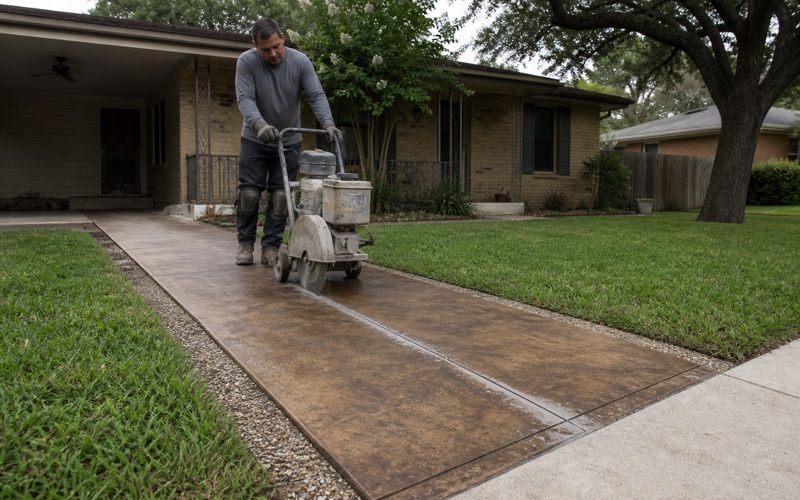
A decorative saw cut border pattern being cut into a cured stained concrete entry in Bryan, slurry running off the blade.

Decorative Concrete

Decorative concrete in Bryan, TX using integral color, acid stains, exposed aggregate, sawcut patterns and borders on drives, patios and entries.

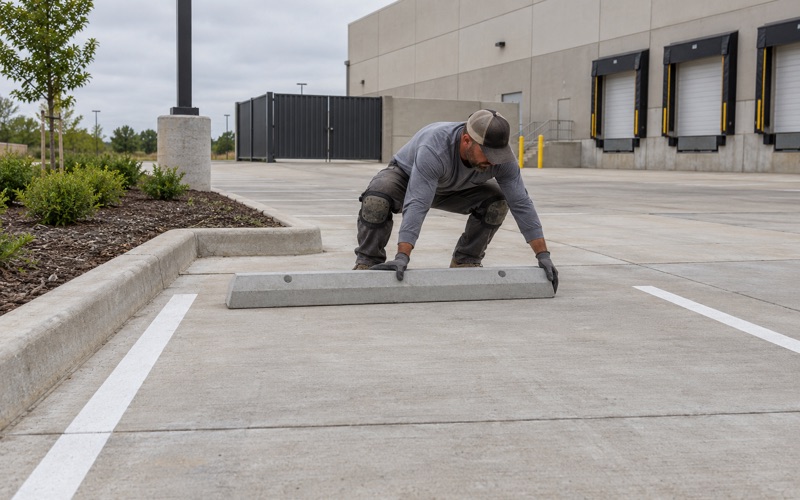
A precast concrete wheel stop being set on a new commercial parking bay in Bryan, the striped lot running away behind it.

Commercial Concrete Contractor

Commercial concrete in Bryan, TX: parking lots sectioned by traffic, dumpster pads, dock aprons, equipment pads, walkways and ramps, phased around you.

Two Decades on Brazos County Ground

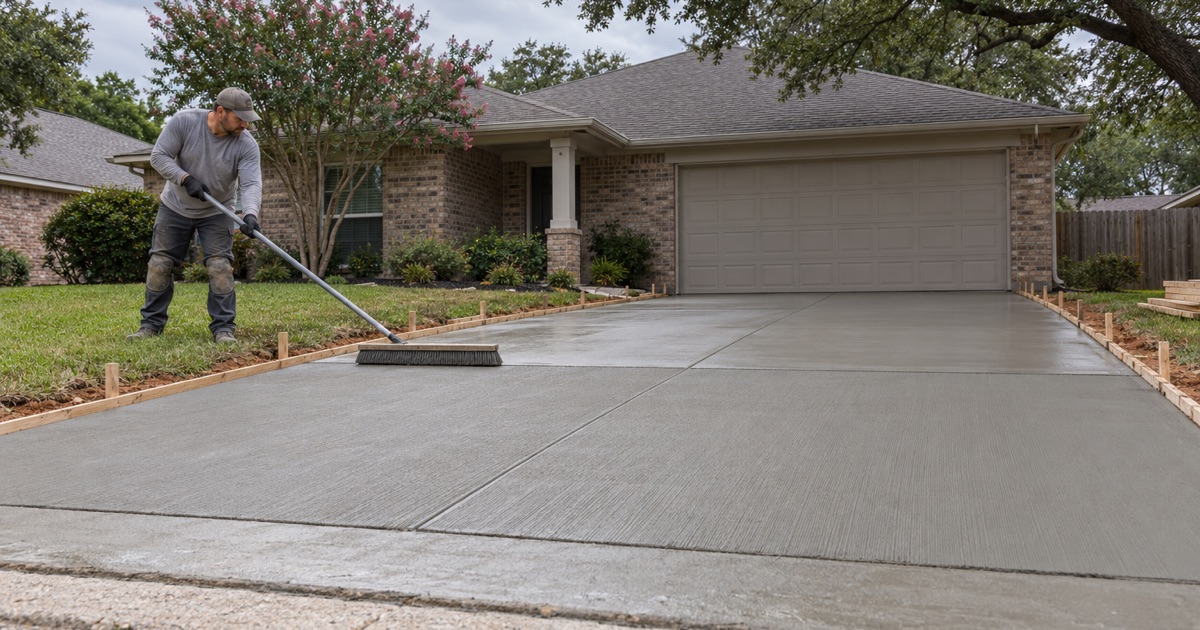
A broom finish being drawn across a new concrete driveway in Bryan, the textured half meeting the still smooth half in a clean line.

20+ Years of Concrete Work in Bryan

More than 20 years in Bryan and the surrounding Brazos Valley is long enough to have gone back to slabs we poured a decade ago and seen how the ground treated them. That record is why we quote subgrade and drainage before finish and color. The failures we are called out to fix are almost never mix problems and almost always ground problems.

Why Choose Bryan Elite Concrete

Subgrade Checked Before Pricing

Every quote starts with what the slab will actually sit on. Because most of this city is a sandy loam over an abrupt clay subsoil, with water collecting where those two layers meet, base correction and drainage are priced into the job rather than discovered halfway through and handed back to you as a change order.

Drainage Designed With the Pour

No slab we place leaves the site without somewhere for water to go. The most common thing we are called out to fix is not concrete that heaved but concrete that lost the dirt underneath it, so fall, edge detail and discharge get worked out with the pour rather than left for a landscaper to solve after the forms come off.

Three Rulebooks, Named Up Front

Bryan deletes the model code’s driveway exemption and redraws the line at the property line, College Station leaves the stock height test alone, and Brazos County runs its own right-of-way regime. Never assume the city next door does it the same way; we name your reviewing authority before you spend money.

Right of Way Work Handled End to End

All work in the public right of way needs a permit and an inspection, and Bryan’s Type D residential right-of-way permit, covering a sidewalk, a driveway repair or a new driveway not tied to a building permit, is set at $100.00 under Section 106-172. We pull it, stake it and meet the inspection rather than pouring first.

County-Sized Driveway Culverts

Never guess a culvert. On county frontage the county determines the pipe, so we take the size from the office that issues the permit and set it to that, rather than dropping in whatever length fits the bar ditch and leaving you solely responsible for a structure the county can order pulled out and replaced.

Thickness and Reinforcement in Writing

Every proposal names the slab thickness, the reinforcement and the square footage before work starts, so our number can sit beside anyone else’s on the same terms. A quote written as a single dollars-per-square-foot figure hides the two decisions that decide whether the concrete is still flat in ten years.

New Concrete and the Ground Under It

An open slab excavation in Bryan whose cut face shows a few inches of pale sand lying directly on stiff clay, with a worker holding a clod of the clay at the face.

How a Concrete Project Runs, Start to Finish

A concrete job here runs from a site visit reading soil, fall and access through layout, excavation, base preparation, forming, reinforcement, placement, finishing, jointing and curing. We walk the grade with you before anything is torn out and put the date you can load it in writing, so you can plan around a driveway you cannot use.

The Duplex Soil Profile Under Most of This County

A duplex profile is a permeable surface layer over a far denser one, and it describes most of Bryan: the Zack, Boonville, Tabor, Zulch and Gredge units cover well over half the city’s mapped soil area, each a low-plasticity sandy surface over a Bt horizon at 45 to 50 percent clay. Rain sinks through the top layer, meets the abrupt permeability contrast and sits. That perched water, not the mix, moves flatwork here.

Concrete Driveways and the Approach at the Property Line

A driveway is two jobs with a line drawn between them. On private property the pour is yours to specify, and Bryan Section 14-47 exempts private drives and sidewalks there from permits and inspections entirely. The approach crossing into public right of way is the city’s: Portland cement concrete to the subdivision construction standards, handled as permitted work.

Concrete Patios Sized Around How the Yard Gets Used

A patio sized to a catalog picture rather than to how the yard is used ends up with furniture on the grass and a grill in the traffic path. We lay it out around the door swing, the shade at the hour you use it and the route to the gate, then set the fall away from the house.

Slabs and Pads for Shops, Barns, RVs and Metal Buildings

Shop floors, barn slabs, RV pads, hot tub pads, shed bases and metal building slabs carry loads a patio never sees, so each is designed from the load rather than from habit. We size thickness, reinforcement and edge thickening to whatever is going on it. A pad poured at patio thickness under a loaded trailer cracks at the wheel path within a season.

Sidewalks and Walkways at the Width and Slope Required

Private walkways can follow the landscape, but anything in the right of way or built under a site plan answers to the city’s design standards for width, cross slope and thickness, and new walks must adjoin existing ones and taper to width. We build to the published standard and show you the dimensions, which keeps a walk from being rejected after it is down.

Footings, Drilled Piers and Grade Beams

Load-bearing work is where the local code narrows the options sharply. Section 14-47 deletes every reference to wood foundations, crushed stone foundations and masonry footings, and sends slabs-on-grade with turned-down footings to the minimum foundation standard added at IBC Section 1907.2. Pier and beam, basement and crawl space foundations need a Texas licensed architect or engineer, and we build to that sealed drawing.

Steps, Aprons and the Smaller Pours That Finish a Job

Steps, landings, garage aprons, trash pads, mower ramps and stoops make a project feel finished, and they are most often left to a second trip that never happens. We schedule them with the main pour so color, finish and joint lines match, because concrete placed weeks later rarely does.

Slab Thickness and When Reinforcement Earns Its Cost

Thickness carries load; reinforcement controls what a crack does once it forms. The two are not interchangeable. On a duplex soil with a swelling subsoil, welded wire reinforcement or rebar on chairs holds a shrinkage crack tight instead of letting it open into a trip edge, and we say plainly where money is better spent on base preparation than on steel.

Drainage, Fall and Where the Water Goes Afterward

Water is the whole argument here. Section 62-296 requires a driveway designed so street drainage stays in the street, typically by setting the driveway elevation at the property line at least as high as the top of curb, and the same logic applies behind the house. We set fall, edges and outfall so runoff leaves the slab rather than standing along it.

When Concrete Sinks, Cracks or Holds Water

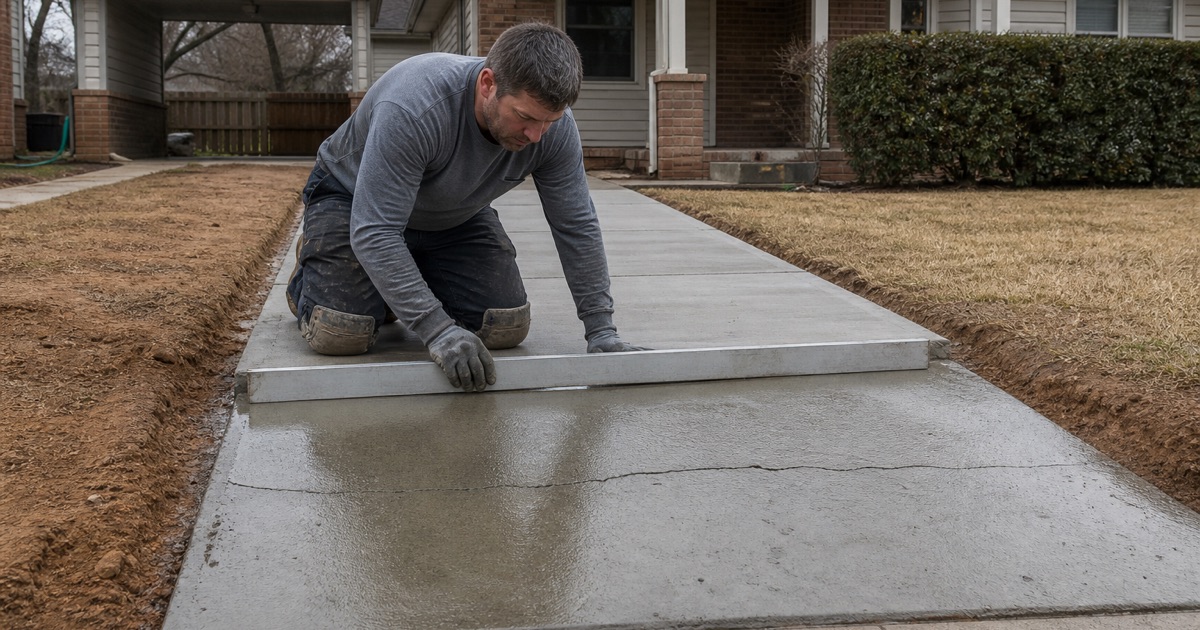
A settled walkway panel in Bryan holding standing water, checked with a long straightedge laid across the low spot.

Why a Concrete Driveway Sinks After Heavy Rain

A driveway that drops after a hard rain has usually not failed as concrete at all. Water found a path along a joint, an edge or a utility trench, moved fine sand out of the base, and the slab followed the void down. The repair therefore starts with where the water enters, not with the panel that moved.

Washed-Out Base Under a Slab, and Putting It Back

Putting the base back means filling the void and compacting what goes into it, not pumping material until the slab rises. We fill, confirm support, then correct the drainage path that emptied it. Skipping that third step gives you a level slab that sinks again in the next wet season.

Concrete Leveling With Polyurethane Foam Versus Mudjacking

Polyurethane foam lifting injects an expanding polymer through small ports, weighs little, cures in minutes and adds no load to a subgrade that is already weak. Mudjacking pumps a heavier slurry through larger holes and costs less over big open areas. We recommend foam where soil is soft or traffic returns the same day, and say plainly when mudjacking is better value.

Concrete Repair Against Full Replacement

The honest test is not how bad the surface looks. It is whether the slab still has continuous support, whether the cracks work seasonally, and whether the damage goes deeper than the top quarter inch. We give the reasoning and the numbers for both routes, because a replacement sold off a photograph of a hairline crack is not a recommendation.

Cracks That Open and Close With the Seasons

A crack that widens through a dry summer and closes after a wet spell is tracking the subsoil, not the concrete, and patching does not stop it. With a Bt horizon at a plasticity index of 38 and a linear extensibility of 7.5 percent under much of the city, some seasonal movement is a design condition. We route and seal those with backer rod and joint sealant.

Sidewalk Trip Hazards and When Grinding Beats Pouring

An abrupt vertical offset at a joint is a liability question before a cosmetic one, and in Bryan repair of a defective public sidewalk or driveway is the abutting owner’s duty and expense independently of any notice. Where the offset is small and the panels are sound, concrete grinding removes it in an afternoon; where the panel is broken or unsupported, grinding only hides it.

Concrete Resurfacing and Overlays

A resurfacing or overlay is a new wearing surface bonded to the slab underneath, so the slab underneath has to be worth keeping. It needs sound support, cracks that are stable, and a surface clean enough to bond. We test that before quoting an overlay, because an overlay bonded to delaminating concrete fails at the bond line and takes the money with it.

A Patio That Drains Back Toward the House

A patio sloping toward the foundation puts every rainfall against the very seam you least want wet. Depending on how much fall is missing, the correction is either lifting the low edge with foam to reverse the slope, or cutting and replacing the affected bays at the right grade. We measure the actual fall with a level before recommending either one.

Spalling and Surface Delamination on New Concrete

Concrete flaking or pitting inside its first year is usually telling you about the day it was placed: water added at the truck, a surface closed before bleed water left, or curing stopped too early. That is a finishing failure, not a material one. We guard against it with a controlled water to cementitious ratio and an acrylic cure and seal applied on schedule.

Joint Resealing and Keeping Water Out of the Base

Joints are the designed weak line and the fastest route for water into the base. Resealing is inexpensive maintenance that prevents the expensive failure, which is why we push it with property managers and homeowners alike. Left open, a control joint becomes the drain that undermines the panel either side of it.

Stamped, Colored and Finished Concrete

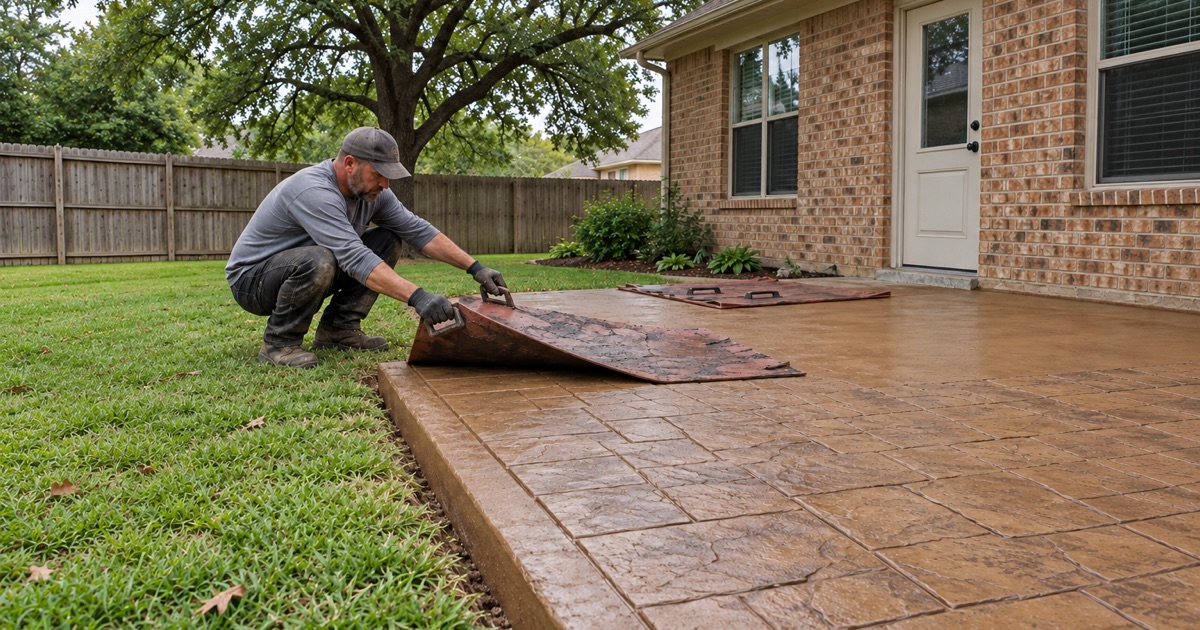
A stamp mat being peeled back off green colored concrete on a Bryan patio, revealing the pattern underneath.

Stamped Concrete Patterns That Suit the House

Stamped concrete takes its texture from mats pressed into fresh concrete, and the pattern that photographs best in a catalog is rarely the one that suits the house. We choose scale and joint layout from the brick, stone or siding already on the property. A pattern too large for the space reads as a print rather than as paving.

Integral Color and Acid Stain in Full Texas Sun

Integral color is mixed through the whole batch, so a chip or a saw cut still shows color, while acid stain reacts with the surface and gives a variegated result nobody can repeat exactly. Both hold better in mid-tone earth ranges than in strong reds and blacks under this much sun. We show samples cured outdoors rather than a color card indoors.

How Hot a Finished Surface Gets Barefoot

Surface color drives surface temperature more than any other decision on a decorative pour, and around a pool or a patio used barefoot that is a comfort question with a real answer. Lighter creams, buffs and light grays run noticeably cooler underfoot than charcoals and dark browns. We raise it at quote time, because nobody wants to learn it in August.

Slip Resistance Around Pools and Wet Areas

Anywhere that stays wet needs texture that works wet and barefoot, not only dry. That points to broom finishes, textured stamps and non-slip additives in the sealer rather than a hard steel trowel. Bryan’s own Travis Bryan Midtown Park guidelines take the same view, calling for a broom finish on walking surfaces expected to be routinely wet.

Broom, Trowel, Salt and Float Finishes

A broom finish drags texture across a floated surface and is the default outdoors for grip. A hard trowel finish is dense and smooth and belongs indoors or under cover. A salt finish gives a fine pitted texture popular around pools, and a float finish sits between broom and trowel. We match the finish to where water and feet will be.

Exposed Aggregate and How It Wears

Exposed aggregate washes or etches the surface paste away to reveal the stone in the mix, giving grip and hiding staining better than a smooth finish. It wears slowly and forgivingly, which is why it survives on older properties. Worth knowing first: Bryan will not replace an exposed aggregate or decorative stone public sidewalk under its cost-share program.

Borders, Banding and Sawcut Patterns

A contrasting border, a soldier course of banding or a sawcut grid turns a plain slab into something deliberate for very little added cost. Sawcut patterns can also be laid out to do double duty as control joints, so the pattern and the crack control are the same lines. We draw that layout before the pour rather than deciding it with a saw afterward.

Acrylic Cure and Seal, and How Often to Redo It

An acrylic cure and seal does two jobs: it holds mixing water in while the concrete gains strength, then leaves a film that resists staining and deepens color. It is a maintenance item rather than a permanent coating, so decorative work needs renewing on schedule. We give you the interval for the product we used and what fading looks like without it.

Matching a New Pour to Existing Concrete

Matching is honest work only if the limits are said out loud. A new pour beside concrete weathered for fifteen years will not be the same shade for a year or more, and cement and sand sources change. We match finish, joint layout and color as far as materials allow, and name where the difference will always show.

Commercial, Code and Right of Way Work

A commercial dumpster pad being formed and reinforced in Bryan, with the approach strip formed out in front of it toward the drive lane.

Parking Lots, Drive Aisles and Heavy-Duty Sections

A parking lot is not one pavement: stalls carry cars while drive aisles and dumpster approaches carry loaded trucks, and one thickness throughout fails at the turning points first. We section the lot by what drives on each part. Section 62-297 requires all off-street parking and maneuvering for passenger and light-truck use to be an all-weather asphalt or Portland cement surface.

Curb, Gutter and Valley Gutter

Curb and gutter contains the pavement edge and carries water to an inlet; a valley gutter moves flow across a drive aisle without a drop that scrapes bumpers. Bryan curbs the perimeter of paved surfaces for everything but single-family residential, and sets minimum heights for wheel stops, islands and raised dividers. We build to the section the city inspects against.

Dumpster Pads, Enclosures and the Truck Apron

A dumpster pad is regulated twice in the Bryan code, in Chapter 102 and Chapter 62, and the two do not agree. Chapter 102 requires a front-load interior pad 12 feet by ten feet at a minimum six inches plus another ten feet in front for the collection vehicle; Chapter 62 requires the pad and says nothing about the apron. We build to the stricter reading.

Curb Ramps and Detectable Warning Surfaces

Curb ramps hold running slope, cross slope and a level landing at once, and a ramp poured slightly steep is a rebuild rather than a repair. Detectable warning surfaces, the truncated dome panels at a ramp foot, are specified by product and sometimes by color: the Travis Bryan Midtown Park guidelines call for cast in place detectable warning surface in colonial red.

Equipment Pads for Generators, Transformers and Chillers

Generator, transformer, chiller and mechanical pads are engineered to the equipment’s own footprint, weight, anchor pattern and vibration, and the anchor layout has to be right before concrete is placed rather than drilled in afterward. We work from the supplier’s template drawing. An epoxy doweled connection into a pad poured to the wrong bolt pattern is a repair nobody should have to buy.

Driveway Culverts on County Roads

On county frontage the driveway crosses a bar ditch, and the pipe beneath it is what keeps the ditch flowing. The county, not the contractor and not the owner, sets the size, and the location is staked and inspected before anything is placed. We file the application, set pipe and headwall to the size issued, then backfill and compact so the drive does not settle over it.

Floodplain Development Permits for Flatwork

In Bryan a floodplain development permit is required for all proposed construction within regulatory floodplains or other areas of flooding identified by the city, administered by the city engineer as floodplain administrator. Development is broader than most owners expect and reaches fill, grading and paving, not only buildings. We check the mapped zone at quote time and tell you before you spend money whether your job needs one.

Which of the Three Local Jurisdictions Your Job Falls Under

Bryan, College Station and Brazos County answer the same residential question differently, and an address can sit inside a city, in its extraterritorial jurisdiction, or on county road frontage. Bryan replaced the model code’s driveway test with a location test at the property line; College Station left the stock height test alone. We identify the reviewing authority first, because the wrong counter costs weeks.

Sidewalk and Street Cut Restoration to Municipal Spec

A cut through a public sidewalk or street goes back to the municipal specification, not to whatever was there before, and that specification names thickness, base, jointing and finish. We restore to the published detail and leave the inspection tag on site as the city requires. A patch that fails inspection comes out again at the contractor’s cost.

Areas We Serve

Bryan Elite Concrete provides concrete contractor throughout the greater Bryan area, with the same crews and the same standards on every job.

Good to know

Frequently Asked Questions

How much does concrete cost in Bryan, TX?

There is no honest single square-foot price, because thickness, reinforcement, base correction, truck access and the finish each move a job substantially. Online city calculators publish figures well below what local contractors actually charge, and they are not quotes. We measure the area, set thickness and reinforcement with you, and put all three in the proposal so our number and anyone else's can be compared on the same terms.

Do I need a permit for a driveway or patio at my house?

In Bryan it depends on which side of the property line the concrete sits. Section 14-47 exempts private sidewalks and drives on private property from permits and inspections entirely, while the driveway approach in the public right of way requires both. College Station uses a different test and county frontage is different again, so we confirm which applies to your address before quoting and pull whatever the job needs.

Are concrete contractors licensed in Texas?

Texas issues no state license for concrete contractors, which surprises most owners. The credential you can actually check locally is city registration: Bryan requires registration with the chief building official for building work, plus a separate Engineering Services registration in four classes covering right-of-way and residential flatwork including driveways, culverts and sidewalks. Ask any bidder what they hold and verify it with the city.

How long does a concrete job take from quote to finished slab?

A residential driveway or patio is usually a few days of site work spread across a couple of weeks, because forming, placing and curing happen in order and none of them can be rushed. Permitted right-of-way work adds the permit and inspection timeline on top. We put the working dates and the date you can load the concrete in writing.

What concrete strength and reinforcement do you use?

Mix and steel are specified to the job and to whichever standard governs the site; around Bryan and College Station public work is written to a 3,000 psi design strength at 28 days. On private flatwork we set thickness, reinforcement type and spacing from the load and the subgrade, then name all of it in the proposal and show you the batch ticket for what arrived.

Should I repair my concrete or replace it?

Replace when the slab has lost support, when panels are broken through rather than cracked, or when the grade itself is wrong and has to be reset. Repair when the concrete is sound and the problem is a joint, an offset, a surface layer or a fillable void. We give the reasoning and both prices rather than steering you toward the bigger invoice.

Can you work around a rental turnover or a tenant move-out?

Yes, and on rental and student housing property here it is usually the whole constraint. A driveway or parking area out of service mid-lease is worth very little to a property manager, so we schedule that work into the turn between leases and commit to the dates. Give us the turn window with the quote request and we build the schedule around it.

What hours can concrete work happen?

Bryan sets authorized construction hours at 7:00 a.m. to 7:00 p.m., Monday through Saturday, and working outside them requires a submitted reason and notice to surrounding occupants through the city's permitting portal. That matters on summer pours, where an early start decides whether a slab is finished in workable conditions. We plan placement around those hours rather than asking forgiveness afterward.

Will new concrete match the concrete already on my property?

Closely, but rarely exactly, and anyone promising exactly is selling you something. Cement and aggregate sources change over the years and existing concrete carries its own weathered patina, so a new pour usually stays lighter for a season before settling toward the old work. We match finish, joint layout and color as far as materials allow and say in advance where a seam stays visible.

Do you offer a warranty, and what does it actually cover?

We warrant our workmanship and stand behind base preparation, reinforcement placement, jointing and finish, which are the things within our control. No contractor can warrant that concrete will never crack: control joints exist precisely because concrete shrinks as it cures. We say before the pour where cracking is being directed and why, so the written terms match what the material does.

Ready to Get Started?

Request a free quote today and we'll get back to you fast.