
Bryan Elite Concrete builds concrete patio work in Bryan, TX and has done for more than 20 years, serving surrounding cities including Lake Bryan, College Station, Hearne, Caldwell and Gause. A patio is the slab people actually use, which makes size, shape and fall matter as much as the concrete specification behind them.
Most patios that disappoint are not badly poured. They are badly sized, or they were laid out to the shape of the house instead of to the way the yard gets used, or nobody worked out where the water would go once several hundred square feet of ground stopped absorbing it. Those are all layout decisions made before anyone orders concrete.
Private flatwork on private property in Bryan is exempt from permits and inspections under the local code amendment, so a back patio is one of the few jobs where the design is entirely yours. That freedom is worth spending on layout rather than on square footage nobody uses.
Getting the Layout Right
Sizing Around Furniture and Traffic
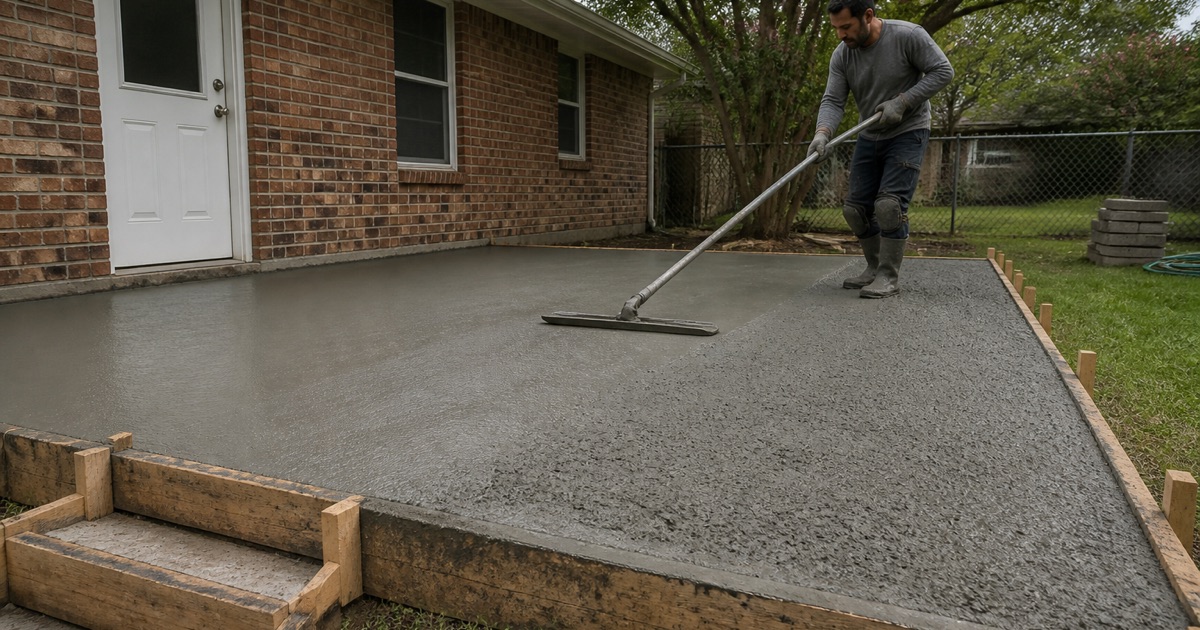
We start with what is actually going on the slab: a table with chairs pulled out, a grill with standing room in front, a walking route from the door to the gate that does not cross the seating area. Those dimensions set the size. A patio sized by budget alone usually ends up big enough to be expensive and small enough to be crowded.
Shape, Borders and Transitions
A patio does not have to be a rectangle, and gentle curves, angled corners or a stepped edge often fit a yard better and cost little extra. Where the patio meets an existing walk, slab or door threshold, we work out the transition and the joint at layout. A change of level discovered during forming is a change of level you live with.
Fall Away From the House
Every patio is graded to shed water away from the foundation, with the amount of fall set so it drains reliably without being noticeable underfoot. Where the yard slopes back toward the house, the answer is a designed edge and a defined outfall rather than more concrete. Getting this right is the single most common thing we are called out to correct on other people’s patios.
Choosing a Finish
Broom, Salt and Exposed Aggregate
A broom finish is the everyday choice: it grips when wet, wears evenly and hides dirt. A salt finish gives a finer pitted texture that suits a poolside or a shaded courtyard. Exposed aggregate reveals the stone in the mix for more texture and better disguise of staining. We match the finish to shade, traffic and how often the surface gets wet.
Stamped and Colored Patios
Stamped texture and integral color turn a patio into a feature, and the choices that matter locally are heat and scale. Lighter creams and buffs stay far more comfortable underfoot in summer than charcoals do, and the pattern should be scaled to the brick or stone already on the house. We plan the stamp layout together with the joint layout so the two do not fight.
Sealers and Ongoing Maintenance
Plain broom-finished concrete does not need a sealer to survive, though one helps with staining under a grill or a planter. Decorative work does need one, and it needs renewing on an interval rather than once. We tell you what went down, when it needs redoing, and what the surface will look like as that point approaches.
Building It So It Lasts
Base, Compaction and Drainage
The base under a patio gets the same treatment as under a driveway, scaled to the load: strip to firm ground, proof roll, correct soft spots and compact the replacement in lifts. Around Bryan the shallow sandy layer over dense clay means water gathers a few inches down, so where it enters and leaves gets designed rather than left to chance.
Thickness, Reinforcement and Joints
Patios carry people and furniture rather than vehicles, so thickness is modest, but reinforcement still earns its place by keeping shrinkage cracks tight instead of letting them open into a lip you catch a chair leg on. Joint spacing is drawn before the pour and, on decorative work, laid into the pattern so it reads as design.
Tying Into an Existing Slab
Where a new patio meets an existing slab we decide deliberately whether to isolate the two with expansion joint material or to dowel them so they move together. Both are valid; picking neither is what produces a random crack across the join. We also set the finish direction and joint layout to line through rather than stopping at the seam.
Covered Patios, Kitchens and Extensions
Footings for Posts and Covers
If a cover, pergola or screen room is going up now or later, the footings for its posts belong in the slab at the time of the pour, not cored through it afterward. Tell us at layout even if the structure is years away. Adding a thickened section or a pier under a future post position costs very little while the forms are still open.
Outdoor Kitchen and Fire Feature Pads
A built outdoor kitchen, fireplace or fire pit is a concentrated permanent load and usually brings gas, water or electrical runs with it. We thicken and reinforce those areas, coordinate the sleeves and conduit before placement, and set fall so runoff does not collect under the cabinetry. Cutting a finished patio for a forgotten gas line is avoidable.
Extending an Existing Patio
An extension is honest work with one caveat said up front: the new concrete will not match the old for a season or more, and cement and sand sources change over the years. We match finish, joint layout and color as far as materials allow, dowel or isolate the connection as the situation needs, and tell you where the seam will always be visible.
- 20+ Years Experience
- Free On-Site Quotes
- Written Scope and Specs